Monday, 6 September 2021

Week 4: the Hub of the Universe

This is the fifth in a series of posts about my Humfrey Wanley Fellowship project, in which I am exploring the Bodleian libraries' unofficial research department in the early twentieth century through the letters of the Parker family, found in the Library Records collection. The first post, which explains the scope and background of the project, is here; there are also posts for week 1; week 2; and week 3.

Harriet really was gathering material, in a leisurely way, for a study of Lefanu, though the Bodleian was not, perhaps, the ideal source for it. But there must be some reason given for her presence, and Oxford is willing enough to believe that the Bodleian is the hub of the scholar's universe. She was able to find enough references among the Periodical Publications to justify an optimistic answer to kindly inquiries about her progress. ~ Dorothy Sayers, Gaudy Night

'Please excuse the most disorderly letter ever written' the American essayist and poet Louise Imogen Guiney (1861-1920) began one of her many letters to Bodleian paleographer and copyist Evaline Parker (1881-1966). An illustration shows what Guiney means by a disorderly letter:

Letter from Louise Imogen Guiney to Evaline Parker, 27 June 1910. Library Records d. 408. Photo: Hope Williard, Courtesy of Bodleian Libraries.

Not only is letter overwhelmed by glued-on postscripts of various lengths and orientations, part of the postscript is cross-written over the beginning of the letter, giving an irresistible impression of energetic enthusiasm. Guiney's forty-odd letters in the Library Records collection are delightful: the products of a gifted and intelligent writer who was head-over-heels in love with the Bodleian.

002_louise_imogen_guiney.jpg
Louise Imogen Guiney, Loyola University Chicago Special Collections.

Louise Guiney was born in Boston, educated in Providence, and began her career as a professional poet, a calling which brought her literary success but no steady income. She first came to England with her mother in 1889, funding their travels by means of travel letters for the Boston Post newspaper, and from 1901 onward was mostly based overseas, getting to Oxford whenever her health and finances permitted.

Of her experiences working in the Bodleian, she wrote in one of her many magazine publications:

One never hears the sound of wheels and hoofs the while, but only the agreeable swish of academic gowns and the year-long voices of birds; and a current of keen fresh air (by the exercise of unique virtue in a library) sweeps from one transept to the other as a daily matter of course, subduing and keeping sweet the musty breath of antiquity. The accommodations for readers are recklessly generous: one has the widest of desks, a thoroughly comfortable chair, good ink, pens, and paper, and bookstands if they be needed. (There is no artificial light on foggy days and there is little heat in winter this is to remind the sybarites of Oxford of the Dominus illuminatio mea, and of that warmth which is not carnal accendat in nobis ignem sui amoris.) The labour-saving devices of our latter day are discountenanced: light-footed boys bring priceless MSS. in their arms and books not marked as reserved for the morrow's study are gathered up again in the same obvious manner and carried in baskets' down the winding staircases and off into the far corners sacred to bequests of Ashmole or Selden, Rawlinson or Douce. At the more recent end, the Carolian end, of the great room stands in its quaint framework a good-humoured but authoritative big bell of the year 1600, a personal friend of the second founder, which rings in and rings out the enchanted seven hours of a working Bodleian day. The library staff has a truly inexhaustive courtesy such as men sadly agree to call the lost courtesy of yesterday. Even the catalogue can hardly be called modern, but you love it while you suffer from it. ~ 'The Three Hundredth Birthday of the Bodleian Library', the Sphere, Saturday 11 October 1902, p. 34.
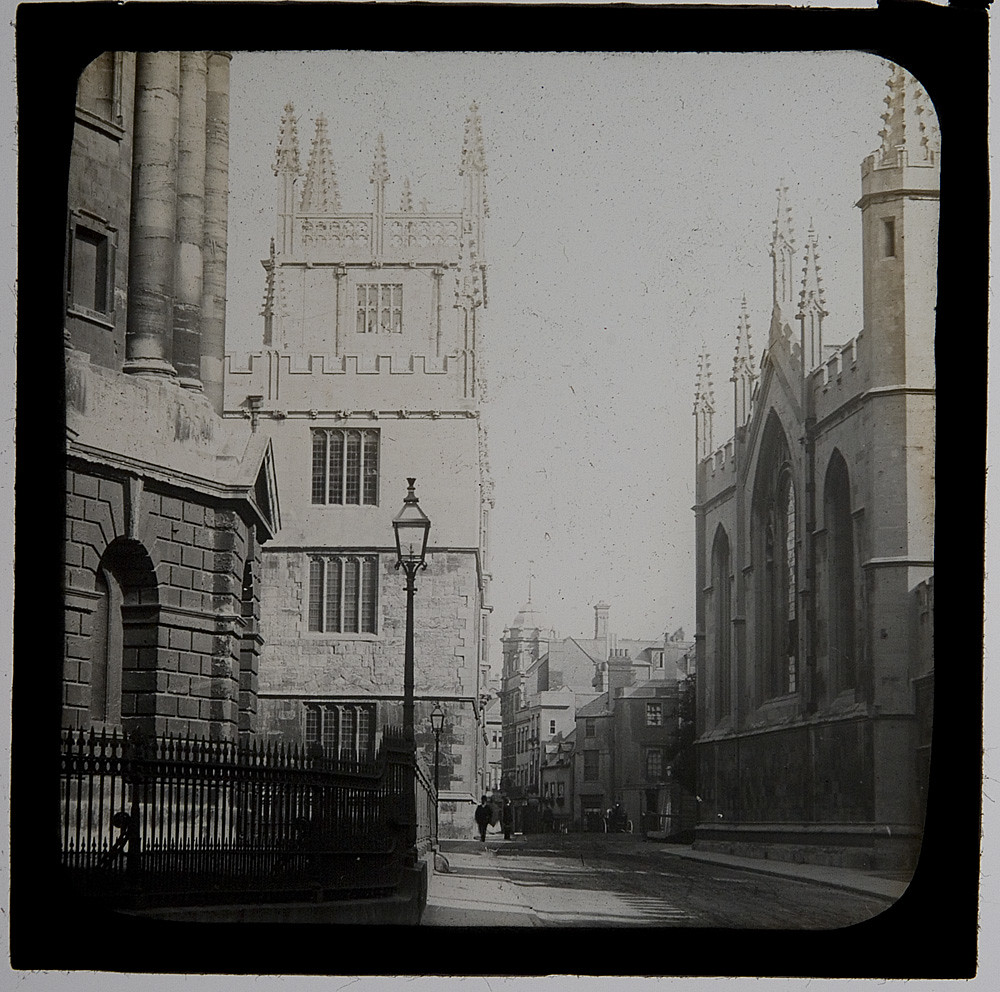
Oxford - Radcliffe Camera, Bodleian Library, & Hawksmoor's Codrington Library (All Souls College), c. 1900
"Oxford - Radcliffe Camera, Bodleian Library, & Hawksmoor's Codrington Library (All Souls College), c. 1900" by whatsthatpicture is licensed under CC BY-NC 2.0

When she needed materials copied or was not in Oxford, Guiney wrote to correspondents at the Bodleian for help. She seems to have been in contact with the Parker family, especially Evaline Parker, from 1903 onward. In March 1903, she facilitated copying for a Mr Gibbon, who kept losing the Parkers' address and writing to them through friends; and in September 1903 pronounced herself very satisfied with a transcription she had requested for her own work.

The bulk of the correspondence dates from between 1908 and 1911, when Guiney was collecting material for her study of seventeenth century English Catholic poets, published posthumously as Recusant Poets, editing the works Henry Vaughan and William Alabaster, and working on various historical essays. The first letter of the series concerns her efforts to gather enough historical evidence to persuade the Bishop of Bristol to dedicate the newly-established Catholic church of St Ives to St Ia.

Louise Imogen Guiney to Evaline Parker, 8 March 1908; Library Records d. 408. Photo: Hope Williard, Courtesy of Bodleian Libraries.
8 March, 1908

Dear Miss Parker,

You may possibly remember me, and your own good services to me, some years back? I should like to claim them again, if I may, as I cannot get back to the precious Bodleian before Easter. I enclose a letter from a friend of mine, a Cornish priest. There is a new Church (R.C.) building at St Ives: he wishes the dedication to stand in the name of the ancient patroness of that borough, Saint Ia. The same was often written Eia, Hya, or even Hy. Can you find her name and date in the Roman Martyrologies? What date do the Bollandists give, Oct. 27 or Feb. 3rd? She is supposed to have been a sixth-century Irish princess, one of the missionary band martyred at Hayle on the south coast of Cornwall. Whatever you can discover will be welcome. (The only references I now know are Baring-Gould, and Smith's Dict. Christ. Biog.) Old Irish Martyrologies would be likely to have her. Look up, too, the point underlined by me in the letter. All this at your leisure.

But as soon as you find it convenient, I should be grateful to have you give me two Latin texts for Zechariah, IX, 17, "For how great is His goodness" etc: one as it stands in Beza (1519-1605), one as in the Vulgate Bible.

Best wishes from yours faithfully,

Louise I. Guiney

Her research in 1908 seems to have focused on seventeenth-century poets John Denham, William Cartwright, and Richard West; when called back to America by her mother's illness late that year, part of Guiney's preparations for her departure focused on gathering what she might need for her work.

Louise Imogen Guiney to Evaline Parker, December 1908. Library Records, d. 408. Photo: Hope Williard, Courtesy of Bodleian Libraries

December 1908

Dear Miss Parker,

Could you possibly let me have these refs. to Twyne Mss? and I will most gladly apply to the Registrars for the needed permission and I thank you for telling me how to go to work. Unfortunately, in view of my going back to America next month (for a quite indefinite period) I have packed away all my reference papers except those needed for my own final explorations at 'the ever-blessed Bod.' and unless you happen to have preserved my note, I shall be in a muddle! I got home from Winchcombe late last evening, and found your letter awaiting me here.

With every best wish, yours,

Louise I. Guiney 

Once established back in Boston, Guiney relied on Parker to keep her supplied with transcripts and references from Oxford.

Louise Imogen Guiney to Evaline Parker, 1 February 1909. Library Records, d. 408. Photo: Hope Williard, Courtesy of Bodleian Libraries

February 1, 1909

Dear Miss Parker:

Many thanks for the very nice transcripts from the Twyne Mss which came two days ago, and for which I enclose the 8s due. You will not be able to lose touch with me, for I shall from time to time need an intermediary at the well-beloved Bodleian. I can hardly realise as yet that I have Gone Down in such a whole-sale fashion! There is deep snow here, and severe cold, but plenty of sun too.

Yours faithfully,

L.I. Guiney

Auburndale, Boston, Massachusetts, USA 

Throughout 1909, Guiney regularly sought references and transcripts from Oxford, and passed on greetings to the friends she had made in the library.

Louise Imogen Guiney to Evaline Parker, 7 April 1909. Library Records d. 408. Photo: Hope Williard, Courtesy of Bodleian Libraries.

7 April 1909

Dear Miss Parker, 

You see I am by no means independent of your kind serviceableness as yet! You are to consult your own convenience entirely in regard to time, etc. Please remember me to Mr Gibson, and also to Miss Stark. How I miss that old musty H-shaped building words cannot say.

Yours with best wishes,

L.I. Guiney 

After her mother's death in February 1910, Guiney did not write again until she had returned to England in June. The seventeenth century continued to fascinate her; and that summer she started working on a study of Oliver Cromwell's conscience, for which she requested references.

August 1 1910 c/o Mrs Harrison, Church St, Ashbourne, Derbyshire

Dear Miss Parker,

Please help me once more! and I will not bother you again for some time. I am following up some interesting Royalist allegations in regard to my Lord Protector and wish to collate some passages, but cannot get up the energy to leave this bookless hermitage just for that. If you are in Oxford and can attack the enclosed references at the Bodleian at once, I shall be much delighted. The ones I have put X against are the ones I want to hear from first; the other four might follow later. The old writers, and Mozley, if he has anything to say about Oliver's looks or supposed bad conscience, are most to my purpose. Kindly copy out all essential passage on the two points named, and send results to this address.

Yours gratefully, 

L.I. Guiney 

Louise Imogen Guiney to Evaline Parker, 1 August 1910, Library Records d. 408. Photo: Hope Williard, Courtesy of Bodleian Libraries

...Please search all these (by indexes or otherwise) for two points only:

1. Any description of Oliver's face which mentions gloomy-looking eyes or lips unusually red.

2. Any description or analysis of an uneasy conscience breeding such fears as made him wear armour under his clothing, etc especially as affecting the gloomy looks aforesaid.

While the article seems never to have been published, Guiney's love of the Bodleian, and its place at the centre of her scholarly universe, continued unabated. After the death of Bodley Librarian, Edward Nicholson, whose uncompromising efforts to modernise the library left him with a divided legacy, Guiney wrote to her friend Strickland Gibson, an assistant at the library:

Longwall Cottage, Oxford, 26th March, 1912.

Dear Mr. Gibson, This is nothing to answer. I only wanted to tell you that I have sent a few paragraphs to the Oxford Times (to be in print, I suppose, this coming Friday) about Mr. Nicholson; I should like your eye to see it there. I hope it shows no undue heat, but it is astonishing to me to hear such remarks about him as I have lately heard from several North Oxford quarters, and I could but do my best to thwart them. I can't bear it, this stupidity which finds petty faults in so large-souled a man. As you imagine, Bodley won't seem the same place to me. I really loved him much. You have all my sympathy in the loss of so good a friend.

Yours ever sincerely,

L. I. Guiney
(published in Grace Guiney, Letters of Louise Imogen Guiney)
 
During the First World War, Guiney was based in Oxford, writing to her friend Helen Ellis:
It is hard to keep one's daily rounds unperturbed, with the German "frightfulness" likely to burst at any moment over the adored spires of Oxford. A bomb on the Bodleian, — and certainly my life, for one, would be worth little thereafter. (3 February 1915, published in Grace Guiney, Letters of Louise Imogen Guiney

After her death in 1920, a small collection of Guiney's research notes were donated to the Bodleian by her executors. There are several collections of her letters in American libraries (including the Library of Congress, Loyola University Chicago, Vassar, and Wellesley) but the letters to the Parker family seem to be little known and I hope that this post serves to bring them to greater attention. Guiney's letters to Evaline Parker shed an interesting light on her scholarly work and her life in England. Given her long and passionate love for the Bodleian, one imagines her being rather pleased that her letters became a part of it.

Further Reading 

Henry G. Fairbanks, Laureate of the Lost: Louise Imogen Guiney (New York, 1975)

Grace Guiney, Letters of Louise Imogen Guiney, 2 vols (New York, 1926)

Louise Guiney, Recusant Poets (New York, 1939)

Eva Mabel Tenison, Louise Imogen Guiney, Her Life and Works, 1861–1920 (London, 1923)

Monday, 30 August 2021

Week 3: A Proper Job

This is the fourth in a series of posts about my Humfrey Wanley Fellowship project, in which I am exploring the Bodleian libraries' unofficial research department in the early twentieth century through the letters of the Parker family, found in the Library Records collection. The first post, which explains the scope and background of the project, is here; there are also posts for week 1 and week 2.

'Well,' said Harriet, 'for one thing, writers can't pick and choose until they've made money. If you've made your name for one kind of book and then switch over to another, your sales are apt to go down, and that's the brutal fact.' She paused. 'I know what you're thinking--that anybody with proper sensitive feeling would rather scrub floors for a living. But I should scrub floors very badly, and I write detective stories rather well. I don't see why proper feeling should prevent me from doing my proper job.' ~Dorothy Sayers, Gaudy Night 

What exactly was George Parker's 'proper job'? On the surface of things, this is easy to answer: he was a senior library assistant (sometimes also described as senior assistant librarian) from 1854 until his death in 1906, an extraordinarily long tenure. But he had another job: from at least at 1896 onward, he somehow managed to fit a full schedule of answering research inquiries around his full-time work. Which did he regard as his proper job? And equally important, how did he do it all?

Part of the answer to this last question was that Parker often wasn't doing the work himself--it might be done by his wife, Angelina, a noted scholar of Oxfordshire dialect; or his daughters Angelina Frances (Annie) and Evaline. The letters they received show that the Parker family worked as a team, passing inquiries among themselves as interest or availability dictated. Additionally, those who wrote to George Parker for help knew that he might ask 'some member of your family' (in the words of a Mr Clark, who wrote on 4 August 1904), to do the copying, transcribing, translation, or reference-checking they required.

Some of these services are still ones libraries provide today: a scan and deliver service is a direct descendant of the work done by professional copyists; and some of the research support we provide is analogous to the reference-checking of the late nineteenth century. There are differences too: few librarians today would provide translation services, and while we would help readers with strategies for proof-reading and checking their references, we would not do it for them.

In the Parker's day, none of the services he and his family provided were an official part of library work, but they still had an acknowledged place within what the library thought its users might need. A fascinating library form from 1901 speaks of the 'private time' of Bodleian staff being used to answer more involved or complicated queries.

Bodleian library, Oxford

20. 4. 1901

The Librarian presents his compliments and has to express his regret that the heavy work of the library does not give its very limited staff time during official hours to comply with requests similar to yours. What you wish can, however, be done in private time at a cost of 2s 6d per hour, and you can limit the time as you like. If you wish it done, the librarian asks you to write to Mr G. Parker at the above address. You need not repeat the inquiry, as your letter will be kept.

photograph of a typed form, with handwritten annotation
Letter from Rev. Canon Houblon, 29 April 1901, Library Records, d. 401. Photo: Hope Williard, Courtesy of Bodleian Libraries.

A few thrifty letter writers reused the Bodleian form in writing to the Parkers about their requirements, which is how these forms made their way into the archives. The transition between 'official hours' and 'private time' seems to have been fairly efficient, judging by the speed with which researchers received replies. One can't help but wonder how this was in practice, and also how someone like George Parker felt about it. Librarians often like to stay with a problem until it is solved--was this an experience Parker shared?
 
On the face of it, the difference between 'private time' and 'official hours' seems pretty clear-cut. As Parker was full-time, his official hours would have presumably been his Monday to Saturday work schedule, and private time would have been any point at which he was of the clock. In practice, was it really so easy to switch between the two? One can imagine Parker at his usual desk, off the clock for the afternoon, preparing to sit down and dig into a nice juicy question, when a reader he helped earlier in the day spots him and hurries over to ask for help...

And what was George Parker doing in his official hours if not assisting readers with remote access to the library and its collections? Fascinatingly, this is a question that can be answered--the Bodleian possesses Parker's staff diaries from 1878-1907, as well as those of other assistants, including Frances Underhill, the first female library assistant. The staff diary was a kind of account book, showing how members of library staff spent their workdays, and each person's diary was inspected annually by library management.

Library Records, f. 21. Photo: Hope Williard, Courtesy of Bodleian Libraries.

As an example, here is what George Parker was up to in early April 1883:

Wednesday, April 4th
Cataloged Books
Checked Invoices.
Looked out books in Catalogue.
Altered headings under Lexicon, 95.
Enter adds. on Acc. Lists, I.

Thursday, April 5th
Catalogued Books.
Searching for a Book.
Revised Slips.
Assisted Readers.
Entered References.

Friday, April 6th
Copied Gal. notes in Greek Canon Ms.
Assisted Readers.
Catalogued Books.
Altered headings under Lexicon, 130.

Saturday, April 7th
Catalogued Foreign Books.
Assisted Readers.
Altered headings under Lexicon, 50.
Entered Adds. on For. Acc. Lists.
 
Updating lists of new accessions, cataloguing, sorted out invoices, helping patrons--many of the tasks Parker lists in his work diary would be familiar to librarians today, even if the emphasis is different. To see how priorities have shifted, let's take a sample page of the diary from August 1880:

Library Records, f. 21. Photo: Hope Williard, Courtesy of Bodleian Libraries.

Tuesday, August 3

Copying the Index to 'Aristophanes' for each copy of the Catalogue. Classified 200 slips.

Wednesday, August 4

Classified 290 slips.

Thursday, August 5

Studying the British Museum Rules of Cataloguing and Arranging titles. Classified 320 slips.

Friday, August 6

Classified 410 slips.

Saturday, August 7

and assisting Dr. Neubauer. Classified 300 slips.

Monday, August 9

and attending to Readers. Classified 380 slips.

Tuesday, August 10

and attending to Readers. Classified 250 slips.

A number of details stand out: the careful attention to the number of slips classified per day as part of a running total of slips classified during the year, and also the contrast between the details of Thursday, 5th August 1880 ('studying the British Museum Rules for Cataloging and Arranging titles') and the afterthought of 'and attending to Readers' on Monday 9 August and Tuesday 10 August. The names of people admitted to the library was recorded elsewhere; so it is perhaps not surprising that Parker's staff diary contains so little detail about who was in the library and what they were doing there. Still, the focus on cataloguing and classification versus reader services suggests the former would be more highly valued when it came time for the diary to be inspected.

Over the next few weeks I look forward to reading more about the history of the Bodleian in order to learn more about what assisting and attending to readers involved, and how this contrasted with the sort of help George Parker and his family were providing in their 'private time'. The difference between private and official hours, on the face of it a simple question, might tell a more complex story whether research work was considered to be a 'proper job' in the late nineteenth and early twentieth centuries.

Further Reading

Barbara B. Moran, “E. W. B. Nicholson and the ‘Bodleian Library Staff-Kalendar.’” Libraries & the Cultural Record, 45, no. 3 (2010): 297–319. My thanks to Oliver House for recommending this fascinating article.

Monday, 23 August 2021

Week 2: Seldom Perfectly Sober

"Do you find it easy to get drunk on words?"
"So easy that, to tell you the truth, I am seldom perfectly sober."
― Dorothy Sayers, Gaudy Night

Twin cultures of bookishness and bibulousness might be said to characterise a university town; reading and drinking were the themes of the letters I read in my second week at the Bodleian. 

I wrote in my first post about how much I enjoyed the style of early twentieth century letter-writers. Here is a wonderful example of what I was talking about--the following is a transcript of a letter from Sir Roper Lethbridge (1840-1919), a British civil servant and Conservative MP, to George Parker, Senior Assistant at the Bodleian Libraries, regarding research into the local history of Devon and Cornwall.

May 23, 1900

Dear Sir,

Mr Nicholson of the Bodleian Library has been so good as to give me your address, and to say that you will be able to do some type-writing (or copying) for me from 2 vols. of Mss in the Bodleian. Will you kindly tell me if you can do it for me, and your charge?

I want to get all the answers (not the questions) copied, to some four questions relating apple-orchards and cyder (beginning with High Bickington--I have done the preceding parishes from A), for each of the remaining parishes (they are in alphabetical order). The reference is Ms. Top. Devon b.1, 2. (beginning at Bickington High).

Wanted, the answers in each parish, to the following questions beginning with the parish of High Bickington.

  1. What is the quantity of acres under Orchard?
  2. What sort of apples are planted or are found to agree best with the soil?
  3. What quantity of cyder is generally made yearly?
  4. Is it remarkable for its goodness? Is it of the rough or sweet sort?
  5. And what is the general value of it per hogshead at the Pounds/month?

I should think that a day or two would be sufficient to take out the replies from the 2 volumes, but if not, I should be glad for you to send on to me each day what you have done, as I am very anxious to at once set to work on the information.

Kindly let me know how soon you can let me have the copy--I enclosed an envelope for favour of reply.

Yours truly,

Roper Lethbridge

[Library Records, d. 400. Courtesy of Bodleian Libraries.]

The combination of polite urgency and precise detail make for a memorable letter. You are perhaps wondering, as I was, how George Parker was supposed to find out the orchard acreage, varieties of apples grown, and quality of cyder in Bickington, High (not to mention the rest of the alphabet)--but thanks to the Reverend Jeremiah Milles (1714-1784), an early pioneer of the research questionnaire, these specific questions could indeed be answered by referring to copies of the information Milles collected in the 1750s. The manuscripts Lethbridge wished Parker to consult can still be found at the same shelfmark he refers to his letter, Mss. Top. Devon b. 1-2.

I'm tempted to request to see it, just so I too might know whether the cyder in High Bickington is remarkable for its goodness.

two mugs of cider sit on a wooden table"Devon Cider 1984" by Rockman of Zymurgy is licensed under CC BY-NC-ND 2.0

Typically, when the Parker family received correspondence that resulted in commissions for research, translation, or transcription, these interactions played out over several weeks or months (Sir Lethbridge's enquiry sparked a flurry of letters which carried on until the information had been copied to his satisfaction, in mid-July 1900). One of the delights watching the conversations play out over time is seeing small personal comments start to slip in--wishes for speedy recovery from illness, congratulations on the birth of a child, messages to pass along to mutual acquaintances, and so on.

One such exchange where we can see a research commission become a social connection was George Parker's efforts to help lawyer and noted social figure Alexander Meyrick Broadley (1847-1916; do read that Wikipedia article if you've never heard of him), track down information about two of his ancestors, William Hayes (1708-1777) and his son Phillip (1738-1793), who successively held the Heather Professorship of Music at Oxford. 

Their music was performed at The Hayes Church Restoration and Grand Concert, which celebrated the restoration of the parish church of St Mary, Bridport, where Broadley's father had been the reverend. George Parker or his family evidently wished to remember the concert, for they made a small scrapbook of newspaper clippings about the event.

Broadley, in turn, seems to have wished to celebrate the occasion with his friends; the last item in Parker's booklet is a menu from the "Diner Hayes" held in the Restaurant Buol, Oxford.

Menu from 13 June 1900. Library Records, d. 400. Photo: Hope Williard, Courtesy of Bodleian Libraries

As someone who loves to cook and eat, I immediately started trying to find out more about the food--the recipes below give a sense of what the dinner may have been like.

  • Côtelettes de Saumon en Aspic Bodleian. Just what would an 'Aspic Bodleian' would taste like? Here is a recipe for cotelettes froides de saumon, which includes an aspic element, and would seem to give an approximate idea.
  • Jambon aux Epinards, Mode Magdalen College. Sauce Mus. Doc. Here is a recipe for jambon aux epinards 
  • Salade aux Fruits á la Doctor William Hayes. Bombe Bumpus Glacee. A bombe glacee is, apparently, Queen Elizabeth's favourite desert.
I have not been able to find out anything about the Soupe Phil Chaise Claire but perhaps it is out there somewhere in an Edwardian cookbook...

Restaurant Buol is long gone and its location at 15 Broad Street is currently vacant, but the memory of fine food and drink lived on. The menu was signed by all the guests and the Parkers carefully preserved it among their papers.

Menu from 13 June 1900. Library Records, d. 400. Photo: Hope Williard, Courtesy of Bodleian Libraries

While cold fish in aspic might not be coming back any time soon, one hopes that occasions like the Diner Hayes will be making a comeback.

Wednesday, 18 August 2021

In the Dark Violin of the Valley

All night a music 
Like a needle sewing body
And soul together, and sewing soul
And sky together and sky and earth
Together and sewing the river to the sea.
 
a dirt path throught a meadow, bisected by a band of mist
4 August 2021

In the dark skull of the valley
A lancing, fathoming music
Searching the bones, engraving
On the draughty limits of ghost
In an entanglement of stars.

In the dark belly of the valley
A coming and going music
Cutting the bed-rock deeper

15 August 2021

To earth-nerve, a scalpel of music

The valley dark rapt
Hunched over its river, the night attentive
Bowed over its valley, the river

Crying a violin in a grave
All the dead singing in the river 
 
13 August 2021
The river throbbing, the river the aorta
 
And the hills unconscious with listening.
 
~ Ted Hughes, from River: Poems by Ted Hughes with Photographs by Peter Keen (London, 1983)

Sunday, 8 August 2021

Week 1: The Proportions and Relations of Things

“I entirely agree that a historian ought to be precise in detail; but unless you take all the characters and circumstances into account, you are reckoning without the facts. The proportions and relations of things are just as much facts as the things themselves.” --Dorothy L. Sayers, Gaudy Night

Greetings from Oxford! My task for the first week of my project at the Bodleian has been to get to grips with the proportions and relations of the archival collections I am working with. In order to plan and prioritise my work, I have been testing my research questions to see if the information I want to find is a) present in the letters I am reading and b) takes a reasonable amount of time to collect. The answers to both questions seems to be yes so far! Because the catalogue of the Parker family letters is not very detailed, I have also set myself the task of working out how many letters there are in total. This has been less successful. It takes me a long time to count because I keep getting distracted by the contents of the letters.

The three questions I want to answer are:

  1. What were the Parkers' knowledge and skills, and how did they acquire these? 
  2. Who was writing to the Parkers, and what does this tell us about the scholarly community in the early twentieth century?
  3. How much were they paid for their research work, and what does this tell us about the value and skill level of this labour?

So far, the range of research inquiries George, Evaline, and Angelina Parker answered seems to have been nearly limitless--everything from historical information that was pertinent to ongoing legal cases, to people researching their family trees, to academics wanting information about Bodleian materials for publications in progress, and much more. One of my favourite series of letters so far is from a French countess, Helene de Noe, who wrote to George Parker on behalf of a Franciscan priest who was preparing an edition of the works of John Duns Scottus. Not only was she deeply involved in the scholarly work of the project, but her letters contain marvelous little details of her daily life, like the time she scrawled a postscript on the back of a letter to apologise for sending Parker a late payment for his work--she'd forgotten her purse at home and didn't have time to go back and get it before the post office closed. Or the time that she wrote that she'd burned her hand and moved house, which left her scrambling to catch up on correspondence.

The letters I have been reading this week date from between 1890 and 1911, and the writing style is exquisitely formal and polite, which is great fun to read. Exceptional courtesy is especially a hallmark of letters from European researchers who chose to write in English (though the letters in French and German are delightfully courtly too.) One letter that particularly stands out was written by a pastor from Hanover, whose unique solution to his language difficulties was to compose his letter in a hodgepodge of German and English. 

In addition to beauties of language and handwriting, some of the letters are written on extraordinarily lovely stationery. Because it has a Lincoln connection, I wanted to share an especially beautiful example.

photograph of a piece of cream-coloured writing paper
Letter from E. Mansel Sympson to Edmund Nicholson, 26 October 1902. Library Records, d. 403. Photo: Hope Williard, courtesy of the Bodleian Libraries 

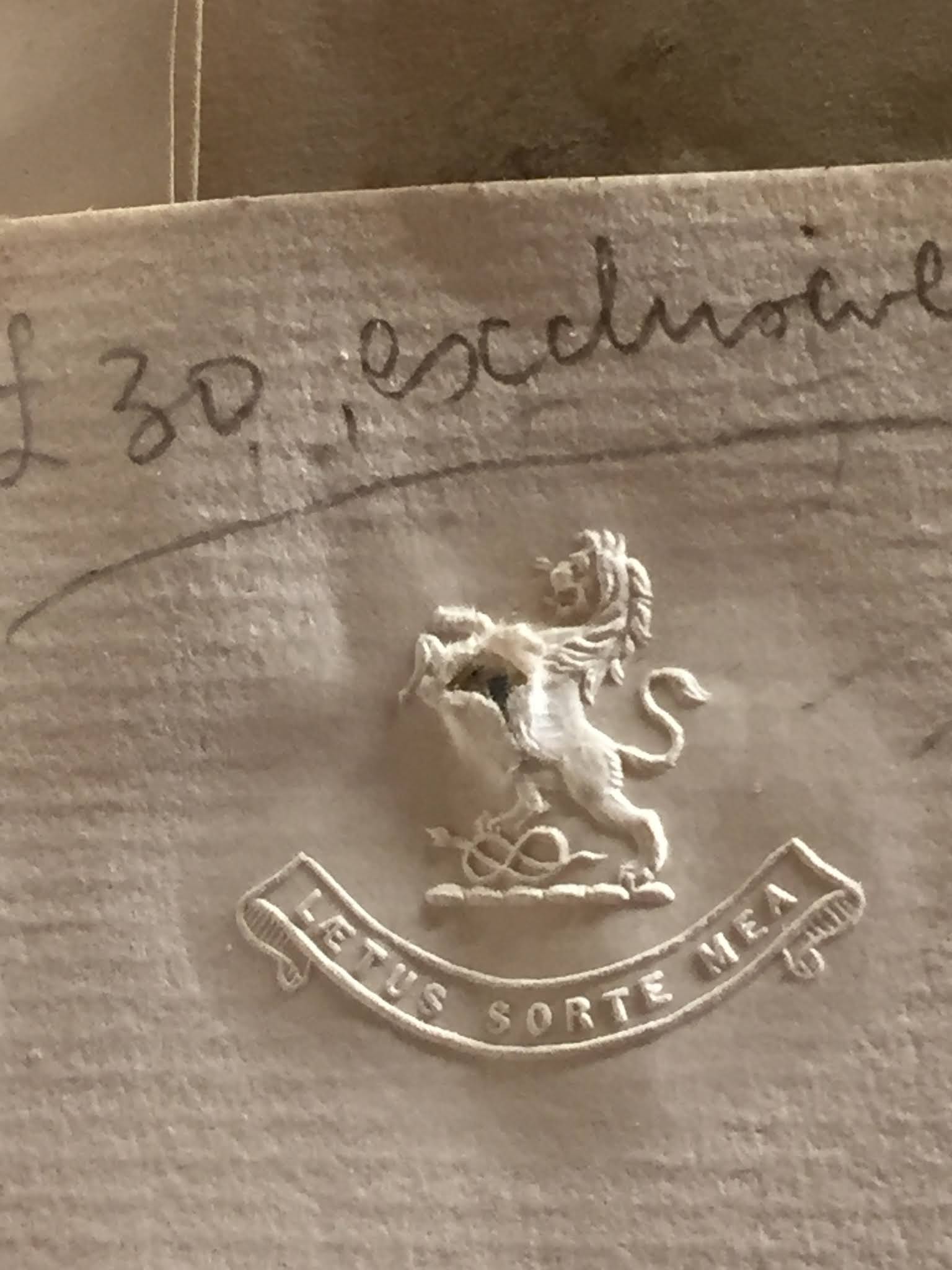
The stationery is a heavy, textured, cream-coloured paper embossed with the Sympson family crest and the words Deloraine Court. Lincoln. This seems to be a Grade II listed building on James Street, in the Minster area of Lincoln; there are pictures here.

Here is a closer view of the crest:

cream-colored writing paper embossed with a rampant lion at the words 'laetus sorte mea'
Laetus sorte mea - 'happy in my lot'. Photo: Hope Williard, courtesy of the Bodleian Libraries

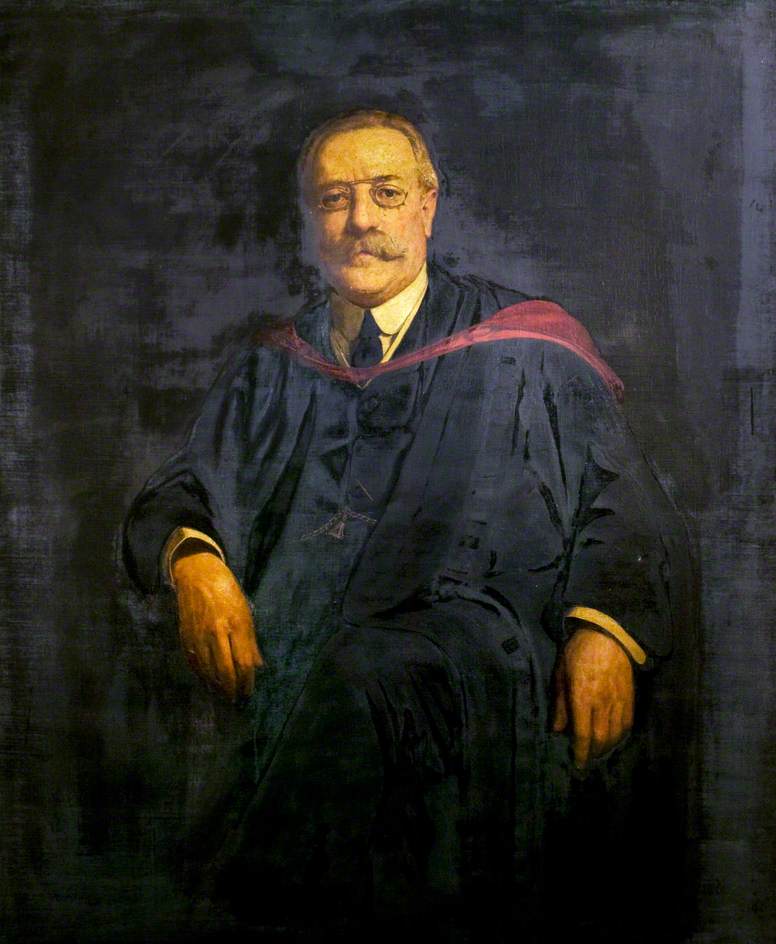
The sender of the letter was Edward Mansel Sympson (1860-1922), a Lincolnshire surgeon and antiquary. Sympson was born in Lincoln and educated at Cambridge. After getting his MD in 1890, he became a surgeon at Lincoln General Dispensary and later Lincoln County hospital. In addition to publishing on the subject of surgical discoveries, he was also a keen archaeologist, and edited the journal Lincolnshire Notes and Queries, as well as publishing books and articles on local history and architecture. His magnum opus, and the subject of this letter, was his book Lincoln: A historical and topographical account of the city, published in 1906. This letter dates from four years before, when he was deep in research. In his letter, addressed to the librarian of the Bodleian, Edward Nicholson, he writes:

October 26, 1902

My dear Sir,

May I first of all congratulate you on the recent Tercentenary of the Library? And secondly may I express my sincere thanks for the great kindness and courtesy shown to me when I was looking over the Lincoln History Ms. last month. It is again about that Ms I am writing to you...

The goes on to request that 'any competent person' made a copy of what he described as 'Lincoln History Ms (Adversaria, or notes for a history of Lincoln)', which is today Ms Gough Linc. 1; a microfilm of the manuscript can be seen in Lincolnshire archives. A member of the Parker family, possible George Parker, noted in pencil at the top of the letter that cost of the copying the full manuscript would be £30, exclusive of paper or postage.

According to the National Archives currency converter, in today's money this would be a whopping £2,357.09, and is the equivalent of three months' wages for a skilled tradesman in 1905.

Why was the copy so expensive? Most of copying of manuscripts seems to have been done by hand due to the limitations of early twentieth century photography. (It's not entirely clear to me when the Bodleian gained a specialist photograph department--particularly between 1900 and 1905, many photography jobs seem to have been passed on to Clarendon Press, whereas copying and transcription were done by the library staff or trusted independent scholars in what are called 'unofficial hours'.) While there are a number of letters which discuss or commission various types of photographic reproduction of manuscripts, most of these are followed by letters complaining that the photograph obscures or cuts off relevant details of the manuscript--and requesting that someone check the real thing in person and supply the missing information. Requests for photographs seem to become more common from around 1909 and later, and the complaints seem to be fewer, probably indicating improvements in photography techniques and technologies.


portrait of a seat white man with a mustache, wearing a black robe with a red collar
The man himself! Dr E. Mansel Sympson, painted by George Henry Grenville Manton, Usher Gallery

While the language of the letter seems to indicate that Sympson was prepared to pay for the copy whatever it cost, so far I have not found a second letter definitely indicating that the good doctor chose to have the copy made. Perhaps Sympson pursued further Lincolnshire research, in person or remotely, at the Bodleian in the years leading up to the publication of his book. I will be keeping a eye out for his beautiful stationery in the hopes of finding out!

Further Reading

E. Mansel Sympson, Lincoln A historical and topographical account of the city (London: Methuen and Co, 1906). There is a copy of this book on archive.org and in the University of Lincoln library.

"Obituary: E. Mansel Sympson, M.D., Surgeon, Lincoln County Hospital," The British Medical Journal Vol. 1, No. 3186 (Jan. 21, 1922), pp. 125-126. 


Sunday, 25 July 2021

Something About Oxford

"There's something about this place," said Peter presently, "that alters one's values." ~ Dorothy Sayers, Gaudy Night

The first I knew of Oxford was from Dorothy Sayers' murder mysteries, which I read in my early teens. Gaudy Night is, still, one of what I like to think of as my "cornerstone books"--the books that are so special to me, so fundamental, that I can hardly bear to share them, except on very special occasions. Gaudy Night changed, ever after, the way I think about the life of the mind, romantic relationships, what we owe to our families and what we owe to ourselves, and the impact of studying at the University of Oxford. 

I first came to Oxford as a Visiting Student at Mansfield College, in 2009-2010, and made frequent visits as PhD student and intermittent research trips after I finished my doctorate. And now I get to go back!

The Bridge of Sighs"The Bridge of Sighs" by J.Salmoral is licensed underCC BY-NC-ND 2.0

Why am I in Oxford?

In a week, God willing, I will be in Oxford as a Humfrey Wanley Visting Fellow at the Bodleian Libraries, researching the women who ran the libraries' unofficial early twentieth century research department. It's partly a feminist reclamation project--an attempt to quantitatively and qualitatively demonstrate how male scholars' research and publication was made possible by the labor of women. As a fellow historian once said to me, the purpose of history is not to judge but to understand, so my purpose is not to rail against the dead, but rather to reveal the landscape of possibility and limitation navigated by the women who worked in Oxford's libraries. 

As I wrote in my research proposal for the project,

With the appearance of the hashtag ThanksForTyping on Twitter in 2017, the academic community began new conversations about the ways in which women’s contributions to the research and publications of their male family members have gone unacknowledged. Scholarship has so far focused on written work and associated activities such as co-writing, typing, and editing. Yet the unacknowledged contributions of women to the research process has been comparatively neglected. The Bodleian’s own historic archives provide a unique opportunity to fill this gap. Between 1860 and his death in 1906, Bodleian Senior Assistant George Parker ran an unofficial research department, answering questions about manuscripts from scholars around the world. From at least the 1890s, the majority of research queries, especially those about manuscripts, were answered by his daughters Angelina (nicknamed Anna) and Evelyn. My project will examine the correspondence of George, Anna, and Evelyn Parker, held as Library Records A.6.2.b and A.6.2.d, in order to shed light on the contributions of two remarkable female scholars to the study of medieval manuscripts during the late nineteenth and early twentieth centuries.

My Research Questions

In other words, what's unique about my project is that I'm not focusing on great scholars or landmark publications, but on the step before a scholar writes up their findings--the research process itself. The Bodleian offers a unique opportunity to do this kind of work, because it has an archive of letters from a wide range of researchers, asking a group of female library to workers to answer specific questions about items in the library collections. A preliminary reading of the letters in the Bodleian archive suggested that they could be used to answer three interlinked questions:

  1. How did the Parker sisters learn the skills necessary to study medieval manuscripts? Manuscript studies are made up a series of technical skills--understanding how the book is put together (codicology), understanding the handwriting (paleography), reading the text (language skills), and situating the book and its contents in its wider context in order make sense of what it tells us (historical analysis). The core question is, what were manuscript studies like in the 1890s and prewar period? How did scholars do their work? Is there anything we can learn from their methods of teaching and learning that can be applied to teaching manuscript skills today?
  2. What scholarly networks did Angelina and Evelyn (and George) take part in? By tracking who they were writing to, and about what, I intend to map the national and international scholarly networks in which the Parkers and the Bodleian participated. Thanks to the brilliant suggestion of my colleague Simon Corcoran, I will also be answering this question by looking for mentions of the Parkers in the acknowledgments sections of academic books. 
  3. Lastly, how was the work of the ladies of Bodleian Research valued by their contemporaries? This builds on the how, who, and what, of my first two research questions by seeing what comes of following the money. My preliminary investigation of Parker correspondence from 1898 and 1903 showed that the scholars who requested the help of the Parker sisters frequently inquire after rates or promise payment for work completed. By exploring the financial side of their work, I will hopefully be able to contextualise it within the wider body of work that has been done on women’s employment in the early twentieth century.

“Wherever you find a great man, you will find a great mother or a great wife standing behind him—or so they used to say. It would be interesting to know how many great women have had great fathers and husbands behind them.” ~ Dorothy Sayers, Gaudy Night

My research proposal sums it up like this:

My project demonstrates how the archives of major research libraries can reveal unseen scholars and unacknowledged contributions. My work will uncover how informal networks of learning centred on the home and library workplace resulted in the development of professional quality manuscript skills and will influence my development of manuscript studies teaching in the future. The history of the women of the Bodleian libraries research department shows how female scholars made a place for themselves within the rapidly changing fields of nineteenth century historical research and librarianship.

It's a great pleasure and privilege to have the opportunity to explore these questions. I will blog regularly about the progress of my research, so please do follow along!

Outside the Library


"The mellow bells, soaring and singing in tower and steeple, told of time's flight through an eternity of peace; and Great Tom, tolling his nightly hundred-and-one, called home only the rooks from off Christ Church Meadow." ~ Dorothy Sayers, Gaudy Night

a bridge over a river, with trees on either bank"Oxford University Parks" by npdoty is licensed underCC BY 2.0

Alongside spending as much time as possible in the archives, I am also looking forward to living in Oxford. Among the many things I adore about Gaudy Night is the incredibly beautiful descriptions of Oxford's architecture and landscape (see above); it will be great fun to see these places with my own eyes. I am looking forward to many morning and evening runs through the University Parks, Port Meadows, Christ Church Meadows, and more--I'm planning to balance exploring old favourites with new discoveries and complete at least two Oxford parkruns. This will be my first visit to Oxford as a keen runner, so I'm hoping to visit the Sir Roger Bannister running track.

After eighteen months of working from home, it's going to be a big change to be around people again! Socially, I want to make the most of opportunities to meet new people and renew acquaintances. I aim to listen generously and make other people laugh. I also want to attend as many classical music concerts as I possibly can--one of my fondest memories of my time as a visiting student was playing violin and viola in as many Oxford orchestras and chamber music ensembles as I could fit into a week--it's a terrific place to be a music-lover, and live music is one of the things I have missed most in the pandemic.

I'm enormously grateful for this opportunity and I hope you will enjoy reading about it as much as I will enjoy writing about it.

Sunday, 18 July 2021

A Poem for "Freedom Day"

Grumpy old man"Grumpy old man" by Spamily is licensed under CC BY-NC-ND 2.0

The United Kingdom has lived under a significant level of restrictions for much of the pandemic and most of these are being lifted on Monday, 19 July, dubbed 'Freedom Day' by the press. With the number of Covid cases on the rise, there are mixed feelings about this. Public opinion about the easing of restrictions is divided, and many clinically vulnerable people are preparing to restrict their movements and interactions in order to keep themselves safe.
 
For myself, I plan to continue living as quietly and cautiously as I can; here is a poem that helps me see the humour in this. I hope it makes you smile too.

Wishes of an Elderly Man, Wished at a Garden Party, June 1914

I wish I loved the Human Race;
I wish I loved its silly face;
I wish I liked the way it walks;
I wish I liked the way it talks;
And when I'm introduced to one
I wish I thought What Jolly Fun!  

~ Walter Alexander Raleigh, reprinted in the Zoo of the New, ed. Nick Laird and Don Paterson (London, 2017), p. 425.