Showing posts with label coronavirus. Show all posts

Thursday, 25 November 2021

Someday

I'm teaching a class on ancient graffiti and someday when this plague is over, I want to visit some of the places we have discussed.

  • Pompeii and Herculaneum
  • Ostia
  • Smyrna
  • Aphrodisias
  • Dura-Europos
  • El-Kurru
  • Tikal
Pompeii

"Pompeii" by Mark Vuaran is licensed under CC BY 2.0


Someday.

Sunday, 18 July 2021

A Poem for "Freedom Day"

Grumpy old man"Grumpy old man" by Spamily is licensed under CC BY-NC-ND 2.0

The United Kingdom has lived under a significant level of restrictions for much of the pandemic and most of these are being lifted on Monday, 19 July, dubbed 'Freedom Day' by the press. With the number of Covid cases on the rise, there are mixed feelings about this. Public opinion about the easing of restrictions is divided, and many clinically vulnerable people are preparing to restrict their movements and interactions in order to keep themselves safe.
 
For myself, I plan to continue living as quietly and cautiously as I can; here is a poem that helps me see the humour in this. I hope it makes you smile too.

Wishes of an Elderly Man, Wished at a Garden Party, June 1914

I wish I loved the Human Race;
I wish I loved its silly face;
I wish I liked the way it walks;
I wish I liked the way it talks;
And when I'm introduced to one
I wish I thought What Jolly Fun!  

~ Walter Alexander Raleigh, reprinted in the Zoo of the New, ed. Nick Laird and Don Paterson (London, 2017), p. 425.

Sunday, 28 March 2021

Running the Length of the Subway

Over the past year, I have come to enjoy virtual racing. Not everyone is a fan. I've heard a lot of hosts and guests on running podcasts bemoaning the absence of 'real races' and dismissing virtual races as a totally inadequate substitute. To which I grumble:

  1. Each their own! Starting a large, urban race with thousands of other people is a unique and special experience. It is completely different from running a solo time trial around your neighbourhood. If you want one and only have access to the other, of course you're going to be disappointed.
  2. Even if it just doesn't do it for you, virtual racing is a meaningful way for lots of other people to find joy in movement.

The last race I ran in person was the Run Your Heart Out 10k, on 23 February 2020, where I was ecstatic to run a chip time of 49:24, setting a personal best in the distance. I was training for the 2020 Manchester Marathon, and regarded this as promising sign that I might be able to break 4 hours on the marathon. The event guide came out just a few days later, and I made arrangement for my father, who was going to be in the UK to see me run, to stay with me in Manchester. On 10th March, participants were assured that the marathon was still planned to take place on 5 April. Three days later, the event was postponed until the autumn, and a new date was quickly announced: 11 October 2020. In July, this too was cancelled, and the marathon was rescheduled for 11 April 2021. This too was pushed back, to 10 October 2021, which is where things stand now.

When I started running virtual races, it was to motivate myself to stay in shape for the marathon, whenever it would take place. In the initial flush of cancellations and postponements, I bought and read several running books, intending to devise a training programme that would keep me improving until I could chase my best times again. Without doing any distance-specific training, I used my first virtual races as time trials to check that I was maintaining my fitness. As the uncertainty started to wear on me, I started to use virtual races as motivational tools to run distances longer than a 10k. In the absence of structured training, I've found distance challenges a valuable way to motivate myself to keep running.

My favourite virtual races have been the two Subway Challenges hosted by NYCRuns. In the first challenge, which took place over the summer of 2020, I ran 245 miles in just over nine weeks.

Finished!
 Logging my mileage was so satisfying and motivating that when a second subway challenge was announced to start in September 2020, I happily signed up. My goal was to complete the challenge of running 691 miles, the length of the New York City subway system, in 26 weeks. Last week was the 26th week and I'm pleased to say I made it, and completed the challenge on the 21rst of March.

Finished!!

Unlike previous virtual races, I struggled with my motivation to finish this one. Part of it was boredom--running in the same places at the same slow paces was getting old, while at the same time I couldn't make myself start, let alone stick, to any sort of structured training. When my goal was just to cover distance, there seemed to be no point in trying to do specific workouts or push my pace.

With the second subway challenge completed, I find myself at loose ends. Theoretically, I'm signed up for the following races:
  • 31 May - Vitality London 10k
  • 27 June - Run for All Lincoln 10k
  • 1 August - Run for All York 10k
  • 5 September - Run for all Leeds 10k
  • 11 October - Manchester Marathon
  • 12 December - Honolulu Marathon

When I signed up for these races in the long ago days of late 2019 and early 2020, my goal was to improve my 10k in order to get speedier and stronger overall. Having spent a year working on neither speed nor strength but just on getting out the door, I'm trying to prepare myself for the fact that I won't beat my 2020 10k time right away. Furthermore, whether I run these races at all depends on the state of the pandemic and vaccine rollout. In order to minimise my risk of catching or transmitting coronavirus, I'm planning to return to in-person racing only when I am fully vaccinated. In the meantime, distance running challenges have been a fun way to run towards that day.

Sunday, 21 March 2021

Songs for One Year

During the first lockdown, I started listening to the blues. Thanks to the Bitter Southerner podcast episode 'Is the Blues Dead?' I discovered the music of Jontavious Willis and listened to his album Spectacular Class on repeat. A year later, the song 'The World is In A Tangle' still lifts my spirits. I hope it makes you smile too.


I listened to a lot of podcasts in the first weeks of lockdown--one that still stands out to me now is the 1619 Project podcast, especially the episode The Birth of American Music, about the role of Black music and musicians in America and the world at large. What I heard led me to subscribe to the Music Maker Relief Foundation's mailing list, and because of their newsletter, I began listening to the music of Mississippi John Hurt. I'll always remember playing his recording of  'You Got to Walk that Lonesome Valley' over and over again in those early days of the pandemic.


It gave me hope and still does. What songs have meant the most to you over the past year? I'd love to hear what you've been listening to.

Sunday, 6 December 2020

Mile 23

 In late October, Shelley Oppel Wood published an essay in Runners' World called 'Stop Calling 2020 a Marathon'. As she points out, the more you think about the parallel, the more it breaks down:

We’ve all heard 2020—a grueling, endless year—described as a marathon. But that only sounds right if you’ve never run one.

This year has indeed felt like the longest of slogs, an endurance test notable mostly for its many varieties of exhaustion and pain. Pandemic and quarantines. Poisonous politics. Violence and rage. And on the West Coast, where I live in Oregon, real fires that fueled the societal ones. But that’s where the parallels end.

With a real marathon, runners know what we’re signing up for. We have months to get in shape. We can find training plans to follow, or even hire a coach. We are mostly in control of the situation, right up to race day—of the miles we log, the dinner we eat the night before, the number of gels we cram in our pockets at the start line.

Unlike a real marathon, we weren’t ready in the slightest for what 2020 has brought.

For me, as someone who has run two marathons and was most of the way through training for a third before it was called off due to Covid, the most apt comparison is not the marathon itself, but to a very specific part of it.

Mile 23.

A marathon is 26.2 miles long, and for a slightly-above-average runner like me, the longest run you ever do in training is about 20 miles. Why? A marathon is hard, physically and mentally, and while you do a structured programme of runs to prepare to do it, you arrive on the start knowing that will be the first time you will try to run the full 26.2 miles.

I felt great for the first sixteen miles my first 26.2-miler, the 2018 Yorkshire Marathon. I was doing it! I was running a marathon! And then the rain got into its stride and I realised I had ten more miles to go, and by the time I hit mile 20, I was simultaneously bored and sore and incredulous--I had to keep going for 6 more miles? For real? (A note on being bored: the Yorkshire marathon course is mostly out in the countryside around York--you hit the Minster and the amazing high-fiving vicar within the first 5-10k, and then you are just plodding down flat country roads in rural Yorkshire. Which would be beautiful on a sunny day, but is less so in the rain.) By the time I got to Mile 23, I had reached a state of fatalism: I would be running down Yorkshire roads in the rain for the rest of time, and that was that. 

Eventually, mile 23 turned into mile 24, and then seeing the mile 25 sign and hearing people start to yell about the nearness of the finish line, I rediscovered some spring to my step, and realised that this was going to end. I was going to make it. I finished in a time of 4:50:19.

photo of the York skyline at sunset, showing the walls and the Minster tower
The sun came out in the evening, long after the race was over. The nerve!
 

My second marathon, Manchester 2019, was a bit different. For one thing, Manchester is a big-city marathon (about 16,000 runners versus the around 5,000 who run Yorkshire), and a substantial portion of the course runs through various boroughs of the city. For another, I started doing speedwork in my training, which helped me get faster and stronger. And finally, I knew that Mile 23 was coming.

And yet. Mile 23 still felt like it was in the middle of nowhere--physically, emotionally, geographically--and also like it was never going to end. A welcome note of absurdity in the endlessness of Mile 23 came when I passed a guy wearing a white rhino costume.

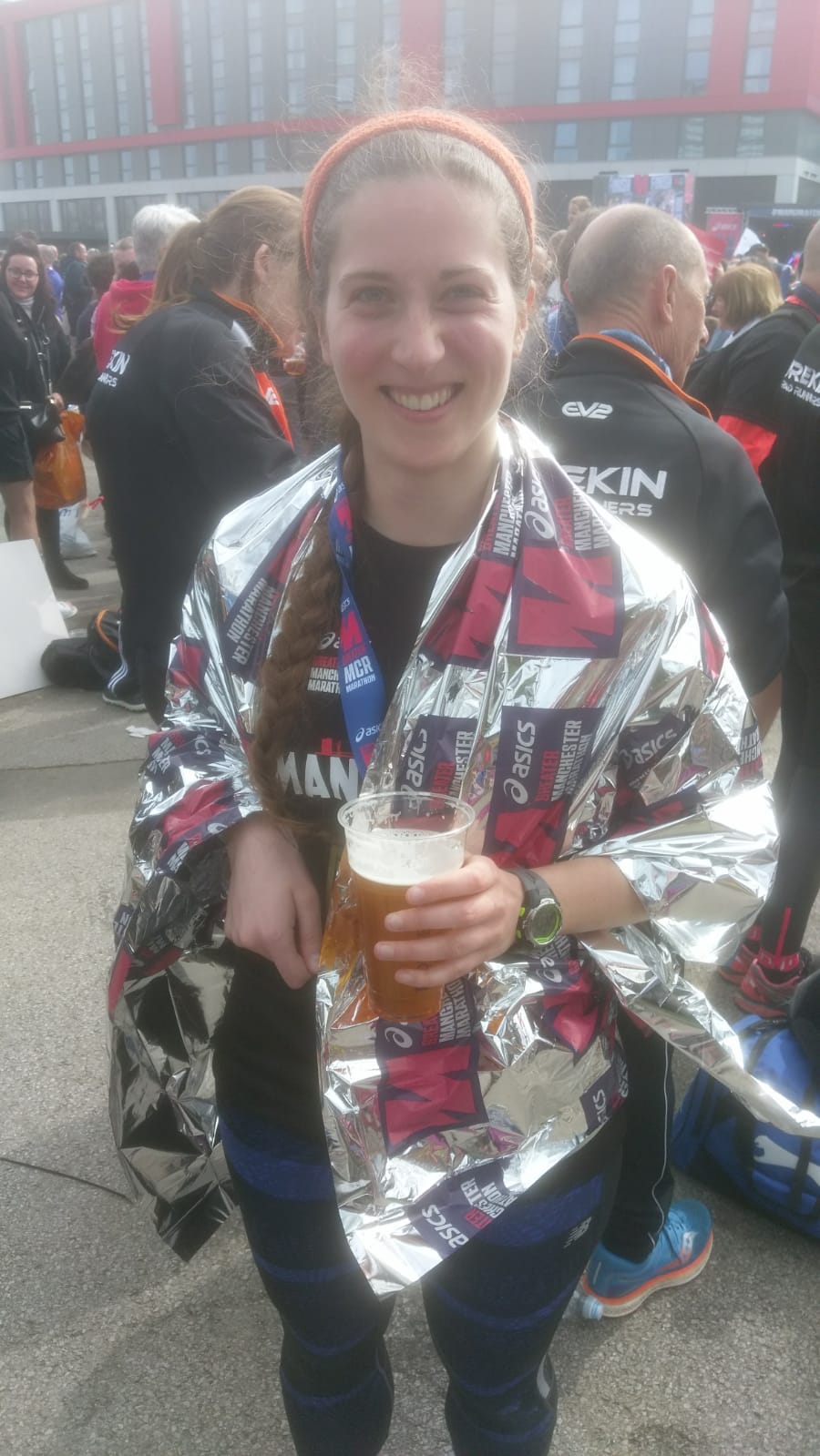
And despite my firm belief that I would be running down the back roads of Manchester for ever and ever, Mile 23 did give way to Mile 24, and then Mile 25. If there was a Mile 25 sign, I missed it, which did have a moment of sending me back to endless-running-land; the race organisers chose to replace it with an enormous television screen showing runners finishing the race, which felt like it was taunting me. But then I looked down at my watch and realised that I had a chance of beating what I thought was my sister's best marathon time, 4:19, and legged it to the finish line, for a 4:18:38 marathon.

a smiling white woman stands wrapped in silver foil, holding a pint of isotonic beer
Finished!

As I've had friends celebrate the tremendous good news of promising vaccines, the end of the second UK lockdown, and even the possibility of a return to normal life, I've been alternately bored and sore and incredulous. We're at Mile 23, I shriek silently, we'll be running this thing forever. And for some people--those affected by unemployment, by domestic and racialized violence, by long Covid, by grief and loss--2020 has no end.

Unlike a marathon, those of us lucky enough to be still on our feet did not train for 2020, but I know I am not alone at Mile 23. May we all reach Mile 24, and Mile 25, and sprint towards the finish line as it comes into view.

Sunday, 1 November 2020

My Favourite Poem

 One Art

 
Lose something every day. Accept the fluster
of lost door keys, the hour badly spent.
The art of losing isn't hard to master.

Then practice losing farther, losing faster:
places, and names, and where it was you meant
to travel. None of these will bring disaster.

I lost my mother's watch. And look! my last, or
next-to-last, of three loved houses went.
The art of losing isn't hard to master.

I lost two cities, lovely ones. And, vaster,
some realms I owned, two rivers, a continent.
I miss them, but it wasn't a disaster.

-Even losing you (the joking voice, a gesture
I love) I shan't have lied. It's evident
the art of losing's not too hard to master
though it may look like (Write it!) like disaster. 
 
- Elizabeth Bishop (from this anthology)

In trying to remember where I discovered this poem, I think first of the Writer's Almanac. This was a short radio segment in which the American radio personality Garrison Keillor read a short poem and offered a brief overview 'on this day in history' centered on writers and literature. Keillor was accused of sexually harassing female coworkers 2017, and his shows disappeared from public radio. Further digging reveals that the Writer's Almanac featured numerous poems of Bishop's over the years, but never 'One Art', so I don't actually know where I first found it. High school, browsing one of the English classroom's Norton Anthologies, having finished my class reading? At university, somehow? I am not sure. It is a poem so much a part of me that I cannot remember when I did not know it. It has spoken to me at many different times in my life. As the UK enters its second lockdown, it seems worth revisiting once more.

Sunday, 4 October 2020

So how's your pandemic going?

The coming week is welcome week at my university, so everything is at sixes and sevens and so am I. Sending every good wish for the physical and mental health of anyone reading this who is also preparing to go back into the classroom or is already there. The UniCovid UK site is both terrifying and helpful reading, and that is all I want to say for now about coronavirus and universities.

Instead, I want to offer a piece of writing that I found helpful. In the May 2020 the Letters Page, one of my favourite periodicals, published a lockdown letter by the Canadian writer Aislinn Hunter. The following paragraphs profoundly spoke to me:

I worry about the usual things: my students, the economy, this awful and unsettling loneliness, the future. But I also worry about the potential for a gulf in understanding to take hold on the far side of this pandemic. It seems almost impossible to imagine what it’s like to wake up to the news that another, and then another, of your neighbours has died, to lose elder after elder in a community, to lose a family member who worked the front lines because that’s what they were trained to do. And I am a writer who spends significant amounts of time in the imagination… I’m someone who recently lost a husband of twenty-five years, though he died in my arms and it was only our world falling apart at the time, not everyone’s.

There’s a feeling you get sometimes walking through a city marked by tragedy – it’s a feeling I had standing in the cathedral in Coventry, in some of the German cities I travelled through last October, in Portbou in Northern Spain where my husband and I spent time after he’d gone though radiation and chemotherapy for his cancer. I worry those who have lost loved ones to Covid – who weren’t able to say good-bye, who live in villages and cities where relations and friends and neighbours were taken in large numbers – will end up standing on the other side of a veil from those who come out of this with a greater remove from the situation. I worry that we won’t be able to meet through language across the two sides of this divide. This is why I think stories and new forms of remembrance will become so important. To witness one event is no small matter but to witness something that sweeps over all of us in an uneven storm will require new forms of empathy; active listening.

Experiences across the pandemic have been so different. Members of senior leadership teams, programme leaders, catering staff, associate demonstrators, trainers at the university gym--even within groups of people who hold the same sort of job, let alone people who work for the same university but have different roles, there has been such an incredible variety of experiences. As the only non-European member of my team, having my entire family an ocean away, and following the coronavirus and other disasters in my home country, has been a different experience from everyone else's. Such differences have at times made me feel extremely alone. As Hunter says, even for someone whose work is literally exercising the imagination, the divide between communities which have been severely affected and communities which haven't is profound.

My own steps to acknowledge this divide have been small ones. Finding myself helplessly enraged whenever I received an email hoping that I had a nice or fun or relaxing summer ('I didn't, but I hope you did' doesn't feel very polite), I have tried to stop beginning emails with 'I hope this finds you well'. In normal times, this seems like an expression of good wishes--in pandemic times, I worry that this assumes the person I am addressing is fine, which is not a burden I want to put on them if they aren't. Instead I try to write things like, 'I hope this finds you and yours well and safe', or 'I hope you are hanging in there', or even 'How are you?' I've moved from closing my emails with 'sincerely' to 'take care'. Another small step that helps me is calling staying apart 'physical distancing' and not 'social distancing'. This reminds me that my social connections are taking some new forms for now, but they are still very much there.

A Sock Update and Other Coping Strategies

Wildflowers in various shades of purple, pink, and orange

Colourful wildflowers growing at a local cemetery

The sun is setting much earlier now, and I don't know what the next few months are going to be like. (Other than, of course, darker. November through February in the UK is a long dark teatime of the soul even in a good year.) One of the joys of taking regular walks through my neighbourhood has been paying attention to changes in the natural world--every few weeks I walk through a local cemetery to see what their wildflowers are doing lately.

It also helps to knit and watch a lot of science fiction & fantasy television. Which brings me to a cheerful place to end--I figured out my second sock.

The top two inches of a dark blue handknitted sock, on wooden needles, rests on top of a completed sock
Second sock success!

Somehow, in a pattern which read:

Rounds 1, 3, 5, 6: knit

Rounds 2 & 4: Knit 2, Purl 2 

I came up with:

Round 1: knit

Round 2: slip 1, purl 1

Part of what took me so long to work this out is I had utterly no memory of slipping stitches, let alone doing so for the entire leg of a sock. 

 Take care.


Sunday, 2 August 2020

New Recipes of Quarantine

I want to start writing about food and knitting again. A lot has changed over the six years since I started writing this blog--I moved to a new city in 2016, graduated with my PhD and got a permanent job in 2017, ran my first marathon in 2018, came to the end of a five-year relationship in 2019, and finished the first draft of the book that my thesis has become in 2020. I don't need to tell you what else happened in 2020, of much greater import than all of that: the coronavirus pandemic.

At the start of the national lockdown in the UK, I began writing down what I was eating every day. I don't even remember why I started to doing it--as someone who can get very anxious, I find activities like counting coins and organising books soothing, so its origins may lie in that impulse to impose order. In those first few weeks, my sister told me about the short story 'So Much Cooking' by Naomi Kritzer, which I read in delight, half-disbelieving that a story told in the form of a food blog could be published speculative fiction, and half-terrified how much it didn't feel like science fiction at all.

After fifteen weeks of recording what I ate for every meal, I stopped. It had started to feel like a chore rather than something that interested me, and chose to record only the new recipes I cooked. Here's the list!

Week 1 (23 March 2020)

  1. chocolate granola from Bosh!
  2. a red cabbage soup from Twelve Months of Monastery Soups
  3. masala chai from Masala
  4. sticky mushrooms from Bosh!
  5. dry-tossed broccoli from Chicken and Rice
  6. Brownies from Heartland
  7. Rutabaga casserole, also from Heartland
  8. Beet Hummus (I had made this the week before)

Week 2 (30 March 2020)

  1. Spicy parsnip soup from Twelve Months of Monastery Soups
  2. Homestyle-Tofu from Food of Sichuan
  3. Bean salad with herbs from Mamushka

Week 3 (6 April 2020)

  1. Buckwheat Mushroom Broth from Mamushka
  2. Piyaz (Turkish Bean Salad) from Persiana
  3. Korean Carrots from Mamushka
  4. Spice-perfumed shoulder of lamb from Persiana
  5. Gluten-free sponge cake from Food 52

Week 4 (13 April 2020)

  1. Tahini Cookies from Jerusalem
  2. Lamb and sour cherry meatballs from Persiana

Week 5 (20 April 2020)

  1. Tadka Dal from Masala

Week 6 (27 April 2020)

  1. Lentil-chickpea salad, from Smitten Kitchen
  2. Chicken roasted over vegetables from Cooking in the Moment

Week 7 (4 May 2020)

  1. Open Kibbeh from Jerusalem
  2. Vegetable Kurma from Masala

Week 8 (11 May 2020)

  1. Custard-filled cornbread from Orangette
  2. Mapo Tofu from Food of Sichuan
  3. Tadka Dal or Vegetable Kurma (my notes are a bit confused)

Week 9 (18 May 2020)

  1. Homemade wheat thins from Smitten Kitchen
  2. Zucchini tofu koftas from Sundays at Moosewood Restaurant
  3. Cuban Black Bean Soup from Twelve Months of Monastery Soups
  4. Spiced Root Vegetable Cakes with Date and Tamarind Sauce from Persiana

Week 10 (25 May 2020)

  1. Beet and Chickpea Salad from Good and Cheap
  2. Crumiri Cookies from Classic Home Deserts

Week 11 (1 June 2020)

  1. Chickpea and carrot burgers, adapted from Smitten Kitchen
  2. Stir-fried celery with minced pork from Food of Sichuan

Week 12 (8 June 2020)

  1. Baked German Potato Salad from Cooking from Quilt Country
  2. Oatmeal Cake from Cooking from Quilt Country

Week 13 (15 June 2020)

  1. Rhubarb Cake from Chocolate With Grace
  2. Red Bean and Rice Soup from Twelve Months of Monastery Soups

Week 14 (22 June 2020)

  1. Rajma Galouti Kebab from Masala

Week 15 (29 June 2020)

  1. Schwenkfelder Cake from Secrets of Saffron
  2. Simplest Spaghetti al Limone from Smitten Kitchen
  3. Yogurt Drop Scones (Oladky) from Mamushka

Week 16 (6 July 2020)

This was the week where UK lockdown restrictions eased significantly and I stopped recording what I ate every day. I continued to note down the new recipes I tried!
  1. Greek Breads with Spring Onions from Mamushka
  2. Fennel and Carrot Pot Pie from Food 52 Vegan

Week 17 (13 July 2020)

  1. Lamb Sharma from Jerusalem 
  2. Cabbage Apple Slaw with Sweet Tamarind Dressing from Chicken and Rice

Week 18 (20 July 2020)

  1. Smoky Black Bean Chili, adapted to feature the vegetables I had on hand, from Food 52 Vegan

Week 19 (27 July 2020)

  1. Mr Xie's Dandan Noodles from Food of Sichuan
  2. Stir-Fried Pickled Mustard Greens with Tofu from Messy Vegan Cook

Why and How


Forty-eight recipies over nineteen weeks, an average of 2.47 new recipes a week, feels like a lot. Particularly during lockdown, when I was cooking just for myself. If I had to pin down the reasons I bothered, they would be:
  • I like to eat.
  • It was something to do.
  • It was something nice to do in the middle of a global health crisis.
  • In early March 2020, I purchased a meat share from the local university's farm, something my former partner and I had talked about doing but never actually did. I had a half a lamb in my freezer, and the dinner parties I'd hoped to have weren't going to happen. Might as well do something with all that food.
Lastly, and most importantly, prior to the start of the UK lockdown, when my workplace had switched to a schedule of alternating work from home with work in the office, I hit up my local library to stock up on reading material.

photo of a stack of library books on a wooden table

My local library has a good cookbook section and prior to the shift towards lockdown I had checked out the following food related books:
And as you can see in the picture, I also picked up Chicken and Rice by Shu Han Lee and Bosh! by Henry Firth and Ian Theasby. Having new cookbooks around helped motivate me to try new things.

Secondly, about a year and a half ago I signed up for a fortnightly delivery of fruit and vegetables from Eden Farms, which has been an absolute godsend during the pandemic--it means that I am able to limit my grocery store trips to about one a month. The vegetable boxes in particular are seasonal and change weekly, so one of the reasons to try new recipes is to figure out how to use up what arrives on my doorstep.

So in sum, I had the privilege of the time, motivation, and opportunity to try new things, and the resources to make that happen. It has helped me cope with the current situation, and if you are in a position to cook new things, I hope it is helping you too.