Friday, 14 June 2024

Learning New Words with Lymond: B is for Butter-Tooth

Welcome back to Learning New Words with Lymond, in which I blog my way through the Lymond Chronicles with a specific focus on Dorothy Dunnett's use of rare and obscure words. When I reread The Game of Kings in December 2023, I made a note of every unfamiliar word or reference. In these posts, I will work my way through the alphabet, looking up each new word and reflecting on what it means in context. I hope this practice will improve my own vocabulary and provide opportunities to bask in the beauty and complexity of Dunnett's writing.

We continue with words beginning with the letter 'b'...

barghest

 
Lymond flushed. "Instead of surviving to bellow like a barghest?" (p. 459)

One of most interesting things about tracing a writer's use of rare words is the way it shows what they have been reading. For instance, the use of the word "barghest" suggests that Dorothy Dunnett had been reading Sir Walter Scott, who is one of the earliest writers to use the word in print. The OED defines a barghest as "a goblin, fabled to appear in the form of a large dog, with various horrible characteristics, and to portend imminent death or misfortune."
 

barmecide

 
The procession next time along the top corridor was formidable: a kind of barmecide feast of invalid diet as well as jugs, bowls, bandages and clothes, towels, ointment and a small wooden bathtub bound in brass. (p. 369)
 
The word derives from the patronymic of a character in the Arabian Nights, a prince who provided a beggar with a series of empty dishes, pretending it was a feast. The beggar went along with the joke. The word can be used as an adjective, meaning illusory or imaginary, or a noun, describing someone who offers imaginary or illusory food or benefits. (OED)
 

Bateleur

 
He had the World and the Bateleur in his hand. (p. 534)

The dictionary says a bateleur is a species of short-tailed eagle (Terathopius (Helotarsus) ecaudatus), found in Africa and Arabia. Given that The Game of Kings begins in 1547 and the word is used to describe different kinds of tarot cards, an eagle clearly isn't the right definition. In the tarot deck, the Bateleur is a wild card, or a low-ranked card that can also be worth a lot of points (Wikipedia). The fact that Will Scott has it in his last hand before winning his game of tarocco confirms his skill and his luck as a card player. Again, when I think about the level of research that went into that single card playing scene, I want to applaud. There are academic articles that are less well-researched.

bauchly

 
You'll solve nothing planted there like a couple of bauchly tenors at a glee. (p. 306)
 
An adverb, described from a Scots adjective meaning "weak, poor, pithless, without substance or stamina"; it the adjective can also mean "indifferent," "sorry," or "shaky." (OED). A glee, of course, is an old, old word for a musical entertainment. I do enjoy how Dunnett seems to put older words in the mouths of her characters (the dictionary claims the earliest attested use of bauch is from 1575), and uses more modern, eighteenth and nineteenth century words, in description and narration.

bêtise

 
He retorted instantly. "Oh, nothing better--in the right place. 'It's only right you should know'--I wonder how many that classic bêtise has driven to the river and the dagger and the pillow in a quiet corner." (p. 157)
 
A borrowing from French, meaning stupidity (coming from the French word, bête, foolish, from the Old French word, beste, meaning beast.  In English, "a foolish, ill-timed remark or action; a piece of folly." (OED). A word I would like to adopt into my own vocabulary, once I learn to pronounce it correctly.

bog-orchis

 
Plump clouds like amoretti hung in a blue sky; shining rooks cawed among shining leaves and an otter with a half-eaten fish shivered the bog orchis with his shoulder as he passed. (p. 360)

An older spelling for a bog orchid, which is exactly what it sounds like, a species of orchid that grows in a bog (Malaxis paludosa). (OED) It looks like this:
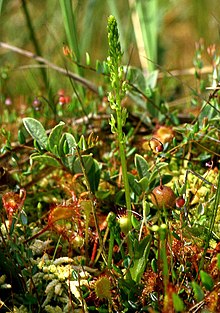
Bog orchis (Malaxis paludosa). Wikimedia Commons.

bonzelike

 
His expression altered from the grave to the bonzelike. (p. 327)
 
I have to say, I miss the internet before the age of artificial intelligence, when one could look up a weirdly spelled word and not have it automatically corrected to a more common spelling. If I meant bronze-like, I would have looked for that! Ugh. Eventually, I was able to disgorge a match, bonze-like, in James Hueneker's Mezzotints in Modern Music (New York, 1899). In any event, this particular word isn't in the OED, but the word bonze is--it means a Buddhist religious teacher or priest, particularly in China or Japan. (OED) We might thus picture Johnnie Bullo's expression moving from serious to serene. 

burin

 
His gaze never left Lymond: inexorable, ruthless, dissecting, hygienic as a burin or a scalpel. And there was a change in his brother's face: a fissure, the first break. p. 447
 
A burin is a tool used by artisans. It is used to work marble or engrave copper. A burin can also be a flint tool with a point like a chisel. (OED). The oldest usage seems to be in reference to copper engraving so I would guess this what Dunnett has in mind particularly since she pairs it with a fine cutting tool (a scalpel). On the other hand, we have fissures and breaks in the next clause, which would suggest stone carving. Isn't it beautiful?

butter-tooth

 
The point was made. Sir Thomas, butter-tooth veiled, seized a pigeon and said no more until the end of the meal. (p. 464) 
 
Where did Dorothy Dunnett acquire her early modern vocabulary, I wonder? Extensive reading was obviously part of it but some of her word choice seems so idiosyncratic as to make me deeply curious what reference books she had at her disposal. The imagery here is just so, so fantastic--Thomas Palmer, at dinner, tweaking the beards of his fellow guests, and then sitting back to enjoy his handiwork. Butter-tooth is first used in the sixteenth century (the earliest use is about 1566), and refers either to the incisors (front teeth); later, especially as a plural, to yellowing or poorly cared-for teeth. (OED)

A Note on Links

 
Through my university, I'm incredibly lucky to have access to the Oxford English Dictionary, and indeed the entire Oxford Reference series of dictionaries and encyclopedias. It is a principle of this blog to try to use and link to sources that anyone can access, but the OED has features--like the ability to explore the etymology, frequency, history of use, and meanings of words, that free online dictionaries simply don't have. My plan is to quote relevant bits of entries, and to include open access links wherever possible, so that anyone who wants to do so can geek out with me, paywalls be damned.

Saturday, 1 June 2024

#AHA Reads 2023: The Gates of Europe

One of the things I enjoy most about this blog is the annual traditions I've come to observe here. It's the end of one year and the beginning of the next? Time for a list of books I finished and a digest of those I would recommend to others! It's the first week of January? New Years' Resolutions ahoy. Summertime? #AHAReads, the summer reading challenge sponsored by the American Historical Association.

I set the following goals for my participation in #AHAReads 2023:

  1. read a history that's been on your shelf too long: Karen Harvey's The Impostress Rabbit Breeder
  2. read a history of a place you know little about: Serhii Plokhy's The Gates of Europe: A History of Ukraine
  3. read a graphic history: The Illustrated History of Football by David Squires

I add two elements to the challenge: writing about what I read and reading only books I own or borrow. In the first annual challenge, I managed to finish all three books between the first of June and Labor Day 2022. (Labor Day, for non-Americans, is the first Monday of September, which many people working in US universities regard as the end of summer because it usually marks the start of the new academic year.) I didn't get around to finishing my blog posts until June 2023. In the second year of the challenge, I read and blogged about only one book between June and September. Finished a second book required borrowing copies from three different libraries in two countries. (What can I say? I take my self-imposed "borrow don't buy" rule seriously.) Continuing my trend of taking a year to finish the challenge, as #AHAReads 2024 begins, here is my final post about what I read last year. 

Hopefully what follows will inspire you to consider reading the Gates of Europe for yourself.

#AHA Reads: 2023 Summer Reading Challenge Bingo Card
 
When the Russian invasion of Ukraine began in 2022, The Gates of Europe regularly appeared on lists of accessible yet scholarly histories which illuminate the historical background of the current conflict. In fact, the book has been popular for about a decade, having been published in the context of the 2014 Ukraine Crisis. (I read the older edition but it's worth noting that a revised edition of the book was issued in 2021.)
 
This context colours Plokhy's choice to foreground Ukraine's complex history as one of connection, and explains the book's title. If The Gates of Europe has a thesis that can be briefly summarised, it is that the history and fates of Eastern and Western Europe are inseparably connected.
"Whatever the outcome of the current Ukraine Crisis, on its resolution depends not only the future of Ukraine but also that of relations between Europe's east and west--Russia and the European Union--and thus the future of Europe as a whole." (p. 354)
This theme of interconnection is also apparent in Plokhy's  account of Ukraine's relationship with its neighbours. I was particularly struck by the richness and complexity of connections between Ukraine and Poland, briefly captured in a wonderful discussion of the relationship between the two countries' national anthems.
"The Ukrainian national anthem begins with the words "Ukraine has not yet perished", hardly an optimistic beginning for any kind of song. But this is not the only anthem whose words do not inspire optimism. The Polish national anthem starts with the familiar line "Poland has not yet perished." The words of the Polish anthem were written in 1797 and those of the Ukrainian one penned in 1862, so it is quite clear who influenced whom. But why such pessimism? In both cases, the idea of the death of the nation stemmed from the experience of the late eighteenth century--the partitions of Poland and the liquidation of the Hetmanate." (p. 147)
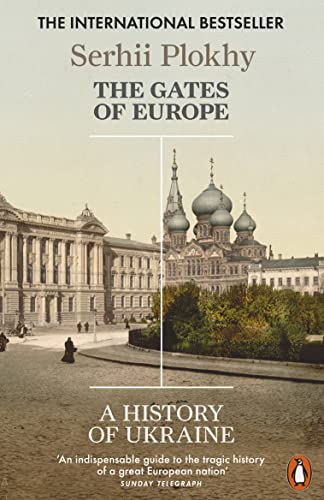
 The Gates of Europe: A History of Ukraine by Serhii Plokhy, Penguin Cover
Having picked up this book knowing nothing about the history of Ukraine, I was amazed and delighted by the sheer scope of this book, which starts with prehistory and ends with the Revolution of Dignity. It begins as a fairly standard survey of dates and dynasties. It broadens into a dense yet rewarding overview of Ukraine's history as the narrative enters the eighteenth, nineteenth, and twentieth centuries. I was particularly fascinated by the history of medieval and early modern Ukraine: the complex legacy of Yaroslav the Wise in education (p. 37); the early history of Ukrainian printing (p. 70); the Cave Monastery and its role in shaping public opinion (p. 83); the challenges of creating the first maps of Ukraine (p. 85); and the Right Bank as both a place and a historical period (p. 117), are all the sorts of historical moments that could fill entire books themselves. So too with Plokhy's observation about the duality of the Age of Enlightenment:
 "The idea of liberty and the protection of individual rights took centre stage in the writings of the period, but so too did notions of rational governance and monarchical absolution. The modern republic and the modern monarchy both have deep roots in the ideas of the French philosophers. Both the founding fathers of the United States and the absolute rulers of eighteenth-century Europe were disciples of the Enlightenment." (p. 134)
The subject of the book does not readily led itself to jokes, which made the few moments of wry humor very enjoyable. Remarking on complex political and religious landscape of eighteenth century Ukraine and its relationship with the Russian Empire, Plokhy comments:
"The Catholic rebels wanted a Catholic state without Russian interference, while the Orthodox wanted a Cossack state under the jurisdiction of Russia. The Jews wanted to be left alone. None of the groups got what it wanted." (p. 139)
In addition to following the shifting tensions and fortunes of various groups in Ukrainian society, The Gates of Europe also traces cultural and economic developments. The former is nicely encapsulated by Plokhy's account of nineteenth-century battles over which alphabet should be used to write Ukrainian. During the alphabet war of 1859-1861, Ukrainians in Galicia fought with Austrian authorities and Polish elites (and amongst themselves) about whether to use the Latin or Cyrillic alphabet for written Ukrainian. Under the rule of the Russian Empire, the use of the Latin alphabet for Ukrainian or Belorussian texts, even imported ones, was banned, lest it bring them under Polish influence. The complex dynamics of Ukraine's relationship with Poland in the eighteenth and nineteenth centuries seem, yet again, to be a subject which could be its own book.
 
In terms of economic developments, the industrial history of the Donbas and Donetsk stands out as a case in point. The latter city was in part the creation of a Welsh mining baron, John James Hughes
"In January 1872, his newly built ironworks produced its first pig iron. In the course of the 1870s, he added more blast furnaces. The works employed close to 1,800 people, becoming the largest metal producer in the empire. The places were the workers lived became known as Yuzivka after the founder's surname ("Hughesivka"). The steel and mining town would be renamed Staline in 1924 and Donetsk in 1961." (p. 180)

One of the pleasures of reading this book is how smoothly Plokhy follows chains of causation. It would be easy for the events of the twentieth century to dominate the book, but these events are always traced back to their earlier roots. For instance, the political divisions of early-twentieth century Ukraine are connected to their roots in the cultural revival of the 1830s and 1840s (p. 193). The foundation of Ukraine's national library, archive, academy of sciences, universities, and even the use of Ukrainian as a national language, are presented not just as a response to events such as the Russian Revolution, but as part of a much longer arc of historical change (p. 211). 

The heart of the book is twentieth-century history: the immense and devastating consequences of collectivization and Ukrainian uprisings in response (p. 249); the beginning of the Holodomor in 1932, and Stalin’s complete denial it was happening (p. 251-3); and the devastating impact of the German occupation of Ukraine during the Second World War (p. 260). Fun medievalist fact: the German invasion of the Soviet Union was named after a twelfth-century Holy Roman Emperor, Frederick Barbarossa. As Plokhy points out, that was certainly a choice.

"[Barbarossa] had drowned while trying to cross a river in heavy armor instead of taking the bridge used by his troops. It was certainly a bad omen, but at the time those in the know paid no attention to historical precedent." (p. 263)

One thing I hadn't known or appreciated before reading this book is the depth and complexity of Ukrainian Jewish history. From the rich history of Ukraine's early modern Jewish communities to the twentieth century history's history of revolutions, this was yet another subject that could be a book of its own. As often happens to me when getting to grips with a totally unfamiliar history, what sticks in my memory is not the broad outlines of historical development, but anecdotes, such as a haunting story about the recapture of Kyiv from the Germans during the Second World War. A Jewish man, who had been hidden by his Ukrainian wife, ran screaming towards Nikita Kruschchev, shouting about being the only Jew left in the city. (p. 277) The book's first (and only) reference to Ukrainian Muslims also occurs in the context of WWII history (p. 268).

The shadow of the second world war in twentieth-century Ukrainian history could itself be yet another book. Plokhy comments:

"As in the camps, the line between resistance and collaboration, victimhood and criminal complicity in the regime became blurred but by no means indistinguishable. Everyone made a personal choice, and those who survived had to live with their decisions after the war, many in harmony, some in unending anguish. But almost everyone suffered survivor’s guilt." (p. 269)

Until the 1980s, Soviet citizens were required to disclose if they or their relatives had lived under German occupation (p. 275). The complex legacies of the Second World War also explain controversies over the reception of figures like Stepan Bandera (p. 335).

The sections of the book that cover Soviet and post-Soviet history are the ones for which I have the fewest notes, possibly a reflection of the points at which I had to put the book down for extended periods. One thing I did notice is the relative lack of references to women. The revolutionary teacher and leader Agafya "Halyna" Andriivna Kuzmenko is covered in a half sentence: "the Ukrainian national agenda was not entirely foreign to Makhno—his teacher wife promoted it" (p. 225). Women feature as significant figures in discussion wider historical developments (see for example pp. 284-5), but often feel surprisingly absent from the wider narrative, which seems a missed opportunity to further strength the book's thesis of complexity and interconnection.

The Gates of Europe: A History of Ukraine book cover
The Gates of Europe: A History of Ukraine by Serhii Plokhy, Basic Books Cover  
Aside from arguing that Eastern and Western Europe are inseparably linked, Plokhy also seeks to showcase the complexity of the entanglement of Ukrainian and Russian history and identities, and to combat simple stories about the relationship between the two countries. Explaining why history matters for understanding the conflict between the two countries, he writes: 
The Russo-Ukrainian conflict, while arising unexpectedly and taking many of those involved by surprise, has deep historical roots and its replete with historical references and allusions. Leaving aside the propagandistic use of historical arguments, at least three parallel processes rooted in the past are now going on in Ukraine: Russia's attempts to reestablish political, economic, and military control in the former imperial space acquired by Moscow since the mid-seventeenth century; the formation of modern national identities, which concerns both Russians and Ukrainians (the latter often divided along regional lines); and the struggle over historical and cultural fault lines that allow participants in the conflict to imagine it as a contest between East and West, Europe and the Russian World. (p. 348)
In 2014, Plokhy concluded his book with measured optimism. "Ukraine faces the enormously difficult task of reforming its economic, political, and legal systems while defending its integrity and sovereignty, but there is growing hope that it can succeed. That hope is based above all on the ingenuity and determination of the Ukrainian people." (p. 345). Reading the book in 2023, and writing about it in 2024, I cannot help but hope he is right.
 

Further Reading 

One thing this book definitely gave me is a list of people whose work or lives I want to learn more about including:
  • Ivan Velychkovsky, Lazar Baranovych, and Simeon Polotsky, all late 17th century writers
  • Ivan Kotliarevsky's, Eneïda (1798), a re-imagining of the Aeneid with Cossack characters, regarded as the first major poem in the Ukrainian vernacular
  • Mykola Tsettelev, who published the first collection of Ukrainian folk songs
  • Oleksii Pavlosky, who wrote the first grammar of the Ukrainian language
  • Mykhailo Hrushevsky, a significant Ukrainian historian 
  • Taras Shevcenko, an important writer and poet, whose life is worth of a historical novel
  • Afanasy Matushenko, a revolutionary socialist who led the Potemkin mutiny and another figure whose life could be a novel 
  •  Olha Kobylianska, a modernist writer and feminist
  • Anne of Kiev, whose letter to her father complaining about the barbarous lack of civilization in eleventh century France makes me want to find a good historical novel about her
  • Roxolana, the consort and wife of the Ottoman Sultan Suleiman the Magnificent

A note on spelling: Plokhy's name is  spelled differently on his Harvard faculty page and on the covers of his books. Both spellings seem to be used in recent articles and spellings so I have used Plokhy here.

Thursday, 23 May 2024

#AHA Reads: 2024 Summer Reading Challenge

Summer is almost here and it's once again time for #AHAReads, the annual summer reading challenge for historians organised by the American Historical Association. Last summer was a bit too full for me to finish but I greatly enjoyed participating in previous years.

Here's this year's challenge!

The goal of the challenge is to complete three challenges--one per month--between 1 June and 2 September--Labor Day in the United States, and the traditional end of summer for many Americans. This year's suggestions are to:

  • Read a history of a place you’re visiting this summer.
  • Read a history by a scholar whose day job is outside academia.
  • Read a co-authored history.
  • Read a history of Indigenous people.
  • Read a piece of historical fiction (novel, story, poem, play) set in the time or place you study.
  • Learn from a historian presenting their scholarship in an amicus brief, digital collection, exhibition, podcast, video, or another format outside traditional academic publishing.

Setting a few bonus guidelines for myself, as I did last year:

  • No purchasing books for the challenge. I must either borrow or own the books I read.
  • Print books only! Summer reading challenges are supposed to be fun, and for me, reading an ebook is not.
  • Blog about what I read and finish writing all posts by 2 September.
 

So which challenges have I chosen and what am I reading?

 
First of all, I want to read a co-authored history: The Bookshop of the World: Making and Trading Books in the Dutch Golden Age, Andrew Pettegree and Arthur der Weduwen's history of the book trade in the seventeenth-century Netherlands. At nearly 500 pages, this is going to be a challenge, particularly since de Bibliotheek Utrecht (from which I borrowed it) only allows two renewals before books have to be returned. 

Trading Books in the Dutch Golden Age ...
The Bookshop of the World
 
Secondly, I aim to read a piece of historical fiction (novel, story, poem, play) set in the time or place you study. My goal here is to read and blog about W.H. Auden's poem "Under Sirius", because it contains a reference to the late antique poet Venantius Fortunatus. Also, Brian Brennan, who writes some of the best articles about Fortunatus, has recently published "Yes, these are the dog days, Fortunatus": W.H. Auden and the Latin Poet Venantius Fortunatus"; and I want to make time to read and enjoy it. Plus, as previously established, I love Auden.

Lastly, I want to learn from a historian presenting their scholarship in an amicus brief, digital collection, exhibition, podcast, video, or another format outside traditional academic publishing.  I subscribe to a few history shows on my podcast app so I may just leave this open. Or, I'll listen to the interview Peter Brown did about his autobiography, Journeys of the Mind: A Life in History.
 
Wishing everyone participating in the challenge a lovely summer of reading and the time and space to enjoy your books.
 

Previous attempts at #AHAReads

Saturday, 30 March 2024

Mostly Unnoticed

The Life of a Day

Like people or dogs, each day is unique and has
its own personality quirks which can easily be seen
if you look closely. But there are so few days as
compared to people, not to mention dogs, that it
would be surprising if a day were not a hundred
times more interesting than most people. But
usually they just pass, mostly unnoticed, unless
they are wildly nice, like autumn ones full of red
maple trees and hazy sunlight, or if they are grimly
awful ones in a winter blizzard that kills the lost
traveler and bunches of cattle. For some reason

14 March 2024
we like to see days pass, even though most of us
claim we don’t want to reach our last one for a
long time. We examine each day before us with
barely a glance and say, no, this isn’t one I’ve been
looking for, and wait in a bored sort of way for
the next, when, we are convinced, our lives will
start for real. Meanwhile, this day is going by per-
fectly well-adjusted, as some days are, with the
right amounts of sunlight and shade, and a light
breeze scented with a perfume made from the
mixture of fallen apples, corn stubble, dry oak
leaves, and the faint odor of last night’s meander-
ing skunk.

—Tom Hennen, source; read in Good Poems, edited by Garrison Keillor (New York, 2003), p. 32.

Friday, 29 March 2024

We need feet. And shoes.

My Goals for 2024 include participating in three reading challenges: books in translation, epistolary fiction, and historical fiction, with the aim of writing two posts about what I read. Here is my first post!

It took two tries for me to finish The Snail on the Slope by Arkady and Boris Strugatsky. My aborted first effort ended when I had to return the book before I finished it, as a consequence of moving to the Netherlands. My new public library was able to purchase a copy and I started again from the beginning and finished it in late February.

[Digression: some advice for users of the public library system in Utrecht. If you are very impatient to get your hands on a book, and it is available at other public libraries in the Netherlands, and you are able to afford a surcharge, consider paying 5€ to order it by interlibrary loan. Purchase suggestions have the advantage of being free but might take five or six months to arrive.]

My interest in the Strugatskys began six or seven years ago when an acquaintance raved about Alexsei German's 2013 film Hard to be a God. To illustrate his point, he showed a clip in which the main character, Don Rumata, sits in a filthy medieval hall among the ruins of a feast and plays the blues on a makeshift clarinet. I was deeply intrigued but never got around to watching the film.

A few years later, I realised that the film was based on a book, and stumbled on a copy of Hard to Be a God the book at the library. It was one of my favourite books I read in 2021, and remains among my favourite works of science fiction. It's absorbing and violent and weird and beautiful and haunting, and asks unanswerable questions about suffering and empathy, scholarly neutrality, and human capacity for change. I read the translation by Olena Bormashenko, published by Gollancz in their SciFi masterworks series. Weirdly, Gollancz does not list Bormashenko's name anywhere on their website--if you search for her there, there are no results. The websites of all the major book retailers follow suit. I was only able to check this detail by getting my copy off my shelf and looking at the title page.

https://m.media-amazon.com/images/I/71UyXEhauPL._AC_UF894,1000_QL80_.jpg
The Snail on the Slope by Arkady and Boris Strugatsky

I stress this point because, while I am 99.9% sure that I did in fact read Olena Bormashenko's translation of The Snail on the Slope, the book page on the Gollancz's website does not mention her, and hence neither do webpages anywhere else. I returned the book to the library so I can't actually check the title page. In the United States, Bormashenko's translation was published by Chicago Review Press, and her name is on the front cover, and included where this book is sold or listed in catalogues. So it is perfectly possible! I really dislike that U.K. edition hides the translator's name, especially since Bormashenko has such interesting things to say about the importance of the Strugatskys, their place in the science fiction genre, and the process of translating their work.

I don't read Russian, so here end my attempts to comment on the fact that this book is a translation. On to the book itself!

Whoever wrote the back cover did an excellent job of introducing the book, so I will quote this in full:

ENTER THE ADMINISTRATION

Peretz spends his days navigating the bureaucracy of the Administration, the institute tasked with governing the Forest below. Except no one ever seems to go there, and his attempts only trap him further within the workings of this strange organisation.

ENTER THE FOREST

Candide cannot remember how he got to the Forest, and he is certain he belongs somewhere else. Determined to escape, he finds that all paths lead him round strange bends and into encounters with bizarre creatures.

NOTHING IS AS IT SEEMS

This classic SF novel sees Boris and Arkady Strugatsky meditate on how little man can understand of the wider world, and in doing so produce one of the great literary works to come out of Soviet Russia.

Do not read this book if you are in the mood for something that makes sense. Do not read this book if you are in the mood for certainties. Do not read this book if you want to be convinced that people are basically good at heart.

Do read this book if you feel like indulging in a wild, trippy, fever dream of a book. Do read this book if you have ever dealt with an insane, arcane, contradictory bureaucracy that seems to invent new tasks and rules and paperwork faster than you can keep with the old ones and it would comfort you to watch fictional characters deal with something similar. People who work in higher education may want to read this book as a form of catharsis. Do read this book if you enjoy stories where "nothing really happens". (Not strictly true of this book at all, but the story-shape of The Snail on the Slope is definitely more of a spiral or a labyrinth than a straight line.) Do read this book if you are the sort of person who enjoys Tolstoy's digressions about the nature of history or Victor Hugo exhaustively detailing the Paris sewer system.

One thing I noticed reading English translations of Andrzej Sapkowski, and that I've found similar in reading the Strugatskys so far, is that the pace of the narrative feels much more meditative and expansive than Anglophone sci-fi and fantasy writing--even though the stories contain a similar level of eventfulness. Things keep coming and they don't stop coming, but the way events are introduced, and the way that characters ruminate on and respond to them, feels gorgeously and expansively slow. 

One of my favourite passages of this nature occurs fairly early in the book when Peretz contemplates books on a bookshelf.

Don't just stand there, he told the books. Slackers! Is that what you were written for? Go on, report to me--how's the sowing progressing, how much have you sown? How much that's good, kind, eternal? And what are the prospects for the harvest? And most important, what has already sprouted? You're quiet...Take you, what do I call you, yes you, the two-volume tome! How many people have read you? And how many have understood you? I really love you, old thing, you're a kind and honest friend. You've never yelled, never bragged, never beat your chest. Yes, you're kind and honest. And those who read you also become kind and honest. Even if only for a time. Even if only with themselves...

But you know, some people believe that we don't particularly need kindness and honesty to move forward. We need feet. And shoes. And even unwashed feet and unpolished shoes will do...Progress may turn out to be completely indifferent to the notions of kindness and honesty, just like it has been indifferent to them thus far. ~ The Snail on the Slope, Arkady and Boris Strugasky, translated by Olena Bormashenko (London, 2019), p. 51

I couldn't get this passage out of my head after I first read it. "We need feet. And shoes." is well on its way to becoming a phrase I quote to myself when faced with particular views of what the Strugatskys call progress. Structurally and thematically, there is a lot about this book I know I missed: I haven't even mentioned the novel's female characters, or anything at all about the other viewpoint character, Candide. This is a book I know I will reread at some point. I wonder what I will notice then?

A treat of the Gollancz edition is the afterword by Boris Strugatsky, which explains the genesis of the novel and its complicated road to publication. Glancing at other reviews, it seems that some people recommend reading the afterword first to prepare for what lies ahead. I don't think it's necessary, but it's fun, when you've finished the book and are sitting there, shaking your head and swearing softly, to get a peek behind the magicians' curtain. 

Further Reading

In searching for information about the translator of Snail on the Slope, I discovered a brilliant book chapter by sociolingustics professor and sci-fi writer R.B. Lemberg, which explores the nuances of translating gender and gendered language from Russian into English. Highly, highly recommended.
 
Lemberg, R.B. (2021). Ungendering the English Translation of the Strugatskys’ The Snail on the Slope. In: Campbell, I. (eds) Science Fiction in Translation. Studies in Global Science Fiction. Palgrave Macmillan, Cham. https://doi.org/10.1007/978-3-030-84208-6_4 . This is behind a paywall but Lemberg published an open-access article about masculinities in the Snail on the Slope which can be read here.
 
Lemberg's website says that they are working on a book about--let me quote to get this right--"translating gender in the works of the brothers Strugatsky and Ursula K. Le Guin". Making a note here to keep an eye out for this book when it comes out--it sounds great!

Tuesday, 26 March 2024

Learning New Words with Lymond: A is for Azulejos

In December I began rereading the Lymond Chronicles by Dorothy Dunnett. This series of six novels follows the career and (mis)adventures of their eponymous character, Francis Crawford of Lymond, a sixteenth century Scottish nobleman "of crooked felicities and murderous talents, possessed of a scholar's erudition and a tongue as wicked as rapier. In The Game of Kings, this extraordinary antihero returns to the country that has outlawed him--to redeem his reputation at risk of his life," as the back cover of my copy has it. (I own used copies of the 1997 American reprint for Vintage Books.)

https://m.media-amazon.com/images/I/71cIFpYS1xL._AC_UF1000,1000_QL80_.jpg
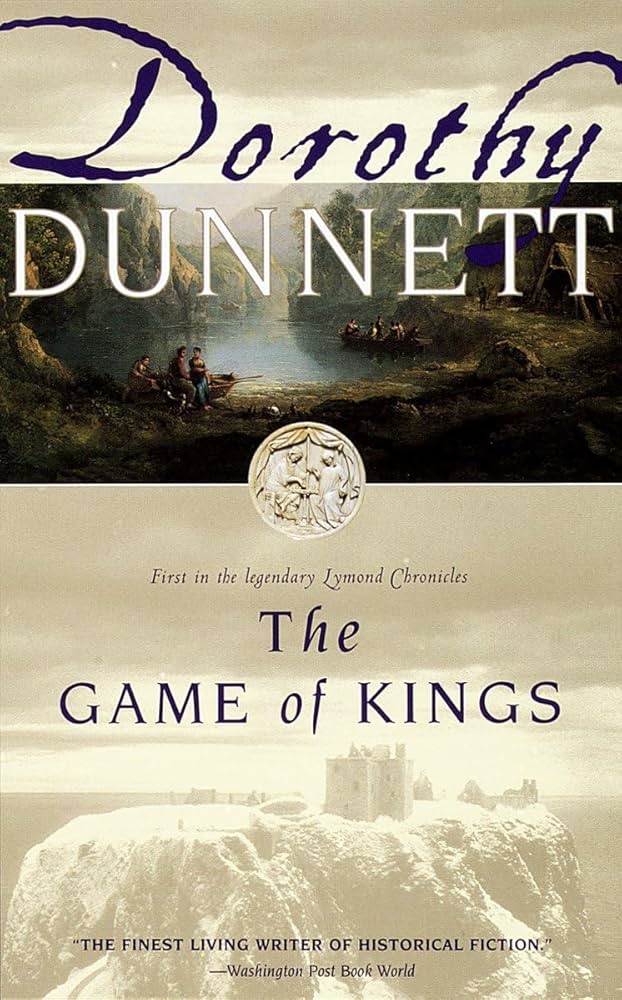
The Game of Kings by Dorothy Dunnett

I love these books. I love these books so deeply I can hardly bear to write about them, because whatever I say will inevitably fail to convey everything I love about the experience of reading them: the dense layers of historical and mythological and literary allusion; the sheer baroque opulence of their use of language; the intricacy of the plots; the deepest imperial purple of their melodrama; the depth and variety of the characters; their wicked, subtle humor; and the way they make me feel. Putting it this way, if "when bad things happen to good characters" is your idea of laissez les bons temps roule as a reader--and it often is mine--you may enjoy Dunnett. I feel absolutely evangelical about these books--I want them to reach everyone who would love them and I want them to be loved by everyone they reach.

Welcome to Learning New Words with Lymond, a series of posts in which I will blog about re-reading the Lymond Chronicles focusing on Dunnett's language and vocabulary. In my reread of the Game of Kings, I made a note of words or references I wanted to look up in the dictionary or encyclopedia and put them in alphabetical order. I hope these posts will function as my own personal Dunnett Dictionary, a way to more deeply appreciate her writing through an in-depth look at the language she uses.

We begin with words beginning with the letter 'a'...

Al-Mokanna

It's a sad world, and the candle is going, so unless like Al-Mokanna you can cause moons to issue from our well, we are destined to sorry together in the dark. (The Game of Kings, p. 352)

Al-Mokanna is a variant spelling of al-Muqannaʿ (“the veiled one”), an eighth-century messianic prophet in Sogdia. He was the leader of syncretic religious movement that blended Islam with other religious traditions including perhaps Buddhism. He and his followers, the Mubayyiḍah, resisted the Abassid caliphate for fourteen years. In the eyes of his followers, he had the power to perform miracles, including making a moon rise and set at his command; Islamic sources attributed this to an illusion involving quicksilver and a well, or an illusion crafted with mirrors, lights, and water. How Lymond (and his author) knew this story, I cannot say. 

Incidentally, the use of the word sorry here--"to sorry together"--is not a typo, but a use of the word sorry as a verb meaning "to sorrow" that comes from Old English.

Further Reading

Here are two open access resources if the above has piqued your interest.

Adam Ali, "Al-Muqanna‘: The Veiled Prophet of Transoxiana", Medievalists.net, 2022 available at https://www.medievalists.net/2022/04/al-muqanna-veiled-prophet-transoxiana

Crone, Patricia “Moqanna," Encyclopædia Iranica, online edition, 2011, available at http://www.iranicaonline.org/articles/moqanna 

amoretti

Plump clouds like amoretti hung in a blue sky; shining rooks cawed among shining leaves and an otter with a half-eaten fish shivered the bog orchis with his shoulder as he passed. (The Game of Kings, p. 360

Not cookies, but a very old word for cupids. (OED). 

Anent

And here's his father, worried yellow in case the poor creature scandalizes the nation and promotes an international incident anent the Buccleuch family. (The Game of Kings, p. 165)

A preposition, coming from Old English and used in Scottish, Irish, and regional English dialects (especially northern). Has an amazing variety of meanings, but the one that makes the most sense here is "with reference to, in relation to; regarding, concerning, about", used in Scottish legal writing from the fourteenth century onwards. OED

Apollyon

No appointment with Apollyon. (The Game of Kings, p. 539)

This one went on my list because, although I've seen it before, I wanted to look up its meaning and origins. Apollyon comes to English from Latin via the Greek word ἀπολλύων ("destroying"); to quote the dictionary, "The destroyer, a name given to the Devil." OED See also Revelation 9:11. I would swear "an appointment with apollyon" is an idiom, but none of the free dictionaries of sayings on the internet yield results.

aposteme

The Dowager reached Ballaggan on the first of August, carying the date in her breast like an aposteme. (The Game of Kings, p. 484)

This is a medieval and early modern word for a large and severe abscess. OED. Dunnet may have conciously or unconciously recalled a line from a poem "Of the Progress of the Soul: The Second Anniversary" by John Donne ("a dangerous Apostem in thy brest").

Asmodeus

Other than apologizing for not being Asmodeus, what can I do? (The Game of Kings, p. 339)

Again, I was vaguely familiar with this name, but wanted the pleasure of looking up exactly what it means. Asmodeus is a character from the Book of Tobit, a wicked angel who kept murdering the husbands of a woman named Sara until the prophet Tobit exorcised him and drove him into Egypt. See Elspeth Morrison, The Dorothy Dunnett Companion (New York, 2001), p. 28.

atavistic

It made him feel uneasy, the prey of dark and atavistic caprice. (The Game of Kings, p. 459)

I've seen this used as an adjective modifying the word greed, but wanted to look up what it means. The dictionary helpfully says, "Of or pertaining to atavism; atavic"; the latter word means "of or pertaining to a remote ancestor." OED

In other words, atavistic is used as a fancy synonym for primal.

atous

"My pretty atous," he said, and admired them, his broad fingers spread across the painted backs. (The Game of Kings, p. 534)

Surprisingly, no joy from the OED, and it was singularly hard to convince the Google algorithm that I was in fact searching for a real word and not misspelling the word autos. Pulling together the French Wikipedia entry on tarot français; this phenomenal post on the Tarot History Forum attempting to trace the etymology of the word tarot; and the board game manuals wiki on "Tarot, tarock and tarocchi games", this is either simply the French word for tarot cards (and the game of tarot as whole); or, as seems more likely, a set of twenty one numbered cards in the total deck; their numbers correspond to their value, with one being weakest and twenty-one being strongest. If I think too hard about how much research went into writing the scenes where Will Scott and Thomas Palmer play tarocco, I might need to lie down on the floor for awhile.

Audhumbla

I have licked you like the cow Audhumbla from the salt of your atrocious upbringing and am watching the outcome with fearful joy. (The Game of Kings, p. 350)

No joy from Oxford Reference or the OED, but there is a Wikipedia entry. Auðumbla is a character from Norse mythology, mentioned in the Prose Edda. She is the primordial cow who fed the frost giant Ymir with her milk and licked away salt from the rocks to reveal Búri, grandfather of Odin and other gods.  Auðumbla is a deeply obscure character--she only appears in the Prose Edda, of which only seven manuscripts survive today. I wonder how Lymond knows of her, let alone thinks of this simile.

azulejos

No rushes covered the floors: these were set with Spanish azulejos and covered with rugs from Turkey and the Levant. (The Game of Kings, p. 124)

Mirabile dictu, the (online) Oxford English dictionary has an error. The OED entry for azulejos reads "a kind of Dutch glazed tile painted in colours" and cites a book from 1845 as the earliest use of the word. But in the Oxford Dictionary of the Renaissance we read,

"Azulejo, The Spanish and Portuguese name (from Arabic al-zulayj, ‘the tile’) for a glazed polychrome tile used in Moorish architecture for exterior and interior walls and for floors. The tiles were typically about 15 centimetres (6 inches) square and brightly coloured, sometimes with geometrical patterns. The reflective surface of azulejos caught the sun, and in Spanish gardens and Portuguese gardens they were used to reflect water. After the reconquista the manufacturing of azulejos continued, often in mudéjar designs." (Campbell, G, "Azulejo," The Oxford Dictionary of the Renaissance (Oxford, 2003), Available from https://www-oxfordreference-com.proxy.library.uu.nl/view/10.1093/acref/9780198601753.001.0001/acref-9780198601753-e-271.

Hey, I'd have those in my house, they sound gorgeous. The fact that the character, Dame Catherine Hunter, who owns the house being described, has azulejos installed and then piles luxury carpets on top of them, tell us something about who she is and who she wants to be.

A Note on Links

Through my university, I'm incredibly lucky to have access to the Oxford English Dictionary, and indeed the entire Oxford Reference series of dictionaries and encyclopedias. It is a principle of this blog to try to use and link to sources that anyone can access, but the OED has features--like the ability to explore the etymology, frequency, history of use, and meanings of words, that free online dictionaries simply don't have. My plan is to quote relevant bits of entries, and to include open access links wherever possible, so that  anyone who wants to do so can geek out with me, paywalls be damned.

Thursday, 21 March 2024

New Recipes of Shorter Days

It's so good to have the longer days coming back again! Happy Spring to all in this hemisphere.

Here are the new-to-me recipes that I've tried over the course of the winter. Soup and Christmas cookies seem to be a noticeable theme. Of the recipes below, the one I tried to recreate from memory a few months later was Ali Slagle warm dinner salad of broccoli with cheddar and dates. (For a substantial and delicious vegetarian lunch or dinner salad, I'm also a huge fan of Erin French's Fried Potato and Warm Lentil Salad.) And I can see myself making the Pork and Sauerkraut with Barley every few years from here on out; it was delicious and very, very easy in the slow cooker, and made for tasty and long-lasting leftovers.

I'm looking forward to discovering and experiencing the spring and summer food cultures of the Netherlands. I learned today from colleagues that the city of Utrecht is surrounded by fruit farms, where you can buy or pick delicious strawberries, so that will be fun to discover as the season turns!

November

  • Simple black bean chili, from Smitten Kitchen Keepers by Deb Perlman
  • Pasta and Lentil Soup from 12 Months of Monastery Soups by Brother Victor-Antoine D'Avila-Latourrette
  • Spicy, Saucy Sichuan mushroom chow men, from Stir Crazy by Ching-He Huang
  • Dutch Pea Soup from Cooking from Quilt Country by Marcia Adams
  • Risotto with Spinach, Raisins, and Pine Nuts from World Vegetarian by Madhur Jaffrey

December

  • Murghi ka keema (ground turkey with green beans), Madhur Jaffrey’s quick and easy Indian cooking
  • Haselnuß Kipferl, Advent by Anja Dunk
  • Technicolor Cookies, Samantha Seneviratne, New York Times
  • Neapolitan Cookies, Sue Li, New York Times
  • Ideal sweet potatoes with buttered nuts, I dream of dinner by Ali Slage
  • Broccoli bits with cheddar and dates, from I dream of dinner by Ali Slagle

January

  • Banana oat cakes from The Breakfast Book by Marion Cunningham
  • Paprikasoep verspakket Albert Hein 
  • Pav Bhaji from Masala by Malika Basu
  • Spiced vegetable soup from Persiana by Sabrina Ghayour 

February

  • Ginger Scallion Hokkien Noodles from the Woks of Life
  • Chicken Chili from Smitten Kitchen
  • Methodist Macaroni and Cheese, from Heartland by Marcia Adams  
  • Dumplings from Good and Cheap by Leanne Brown

March

  • Estonian Pork and Sauerkraut with Barley from Heartland by Marcia Adams
  • Fried Potato and Warm Lentil Salad from The Lost Kitchen by Erin French