![]() |
| "Howlin George Blues singer" by keith ellwood is licensed under CC BY 2.0 |
Musings on late antiquity and the early Middle Ages | Poems, Crafts, and Food
Sunday, 30 January 2022
Barbarians don't get me
Thursday, 6 January 2022
Goals for 2022
At the very beginning of 2021, I wrote a post about my goals for the year. Revisiting them in November enabled me to take pride in what I had accomplished during the year and begin thinking ahead to the new year. Which is now here!
We made it through another year of plague, friends. Hoping you and your loved ones are hale, hearty, and hanging in there. What do you hope the days ahead have in store?
![]() |
| "Resolutions and goals" by creepyed is licensed under CC BY-NC-SA 2.0 |
As a blogger, I will...
- Write at least six posts about researching or teaching late antiquity and the Middle Ages.
- Post at least six translations of Latin texts (or excerpts thereof).
- Write at least one more post about medieval mitten miracles.
- Share at least one post on Facebook or LinkedIn...even though I rarely use social media and am uncomfortable with the idea.
- Continue to find and share contemporary poems about the late Roman period or late antiquity.
- Post at least four substantial translations of Latin texts, aiming for a range of periods, genres, authors, and topics.
- Produce at least twenty-six posts over the course of the year--aiming for two a month, or one every fortnight.
As a historian, I will...
- As I wrote last year, I want to be the kind of person who enjoys a colleague's article or book, hears
about their grant or job success, and always sends them a note of
congratulations.
- Submit a draft of my chapter on Annie Parker and her family to History of Universities by the end of January 2022.
- Submit revisions on my 'Epistolary Miracles in Late Antique Gaul' article by the end of February 2022.
- Submit a draft of my chapter on scale in the letters of Sidonius Apollinaris to the Shifting Frontiers volume by 4 March 2022
- Submit the following book reviews as close to on time as I can.
- a double review of translations of Fortunatus' Life of St Martin to Plekos.de by 1 April 2022
- a review of Latin Poetry and its Reception to Bryn Mawr Classical Review by the end of May 2022.
- a review of The Carolingian Revolution to Speculum by July 2022.
- Not commit to any more book reviews! Exceptions will be made if someone asks me to review a book on the Merovingians or Latin epistolography. Or poetry. Or something else I want to learn more about.
- Work on my modern languages! I want to read at least two substantial pieces of academic writing in French, German, and Italian over the course of the year, and practice regularly, using tools like Duolingo, children's books from the library, and maybe even a language class or two.
- Work on my Latin--once a week, I aim to translate at least three sentences of prose or poetry, as well as work through one grammar review book over the course of the year.
As a knitter and sewist, I will...
- Knit a ten-stitch blanket for myself...or possibly someone else. I love the pattern so much!
- Finish my mother's long overdue and patiently awaited birthday afghan.
- Make at least one square of a quilt or some other beginner project in order to get more comfortable using my sewing machine.
- Attempt to learn nålebinding and complete a small project using this technique.
- Make four pairs of socks.
- I struggle with lace and multi-colour work, so I aim to complete a small project using either technique.
- Cast on and knit at least one part of a sweater. Triple bonus points if it is a pattern by Alice Starmore.
![]() |
| "Love book" by Shaun Amey Photography |
As a reader, I will...
- Read at least 52 books this year.
- Read at least three books on current affairs and issues, including at least one on anti-racist pedagogy.
- Read at least three history books written for a general audience.
- Go to the public library at least once a month.
- Finish reading Dorothy Dunnett's House of Niccolo series.
-
- Read at least two books of essays.
As a runner, I will...
- Try to beat my current best parkrun time of 24:36, which I set in Oxford on 11 September 2021.
- Try to beat my current personal best 10k time of 49:24, set at the Run Your Heart out 10k in Scunthorpe on 23 February 2020.
- Do a core workout every Monday.
- Purchase new shoes from my local running store.
- Try at least one new thing. Ideas: adult ballet, anything in a gym, pilates, street dance, or speed workouts on a track.
- Enter and finish two half marathons.
- Do my best to finish a marathon sprinting, smiling, uninjured, and in less than four hours and fifteen minutes.
As a teacher, I will...
- Update my participation marks regularly, the evening after each class (or that weekend).
- Read at least one book on pedagogy and at least six blog posts on teaching in the university classroom.
- Post all my lecture slides before the lectures.
- Write a content notice for my class on Roman women and discuss it with my students.
- Go back to writing up quick notes for myself after each lecture, focusing on the traffic light system (i.e., make quick notes on what I will start, stop, and continue to do the next time I teach the material).
- Look for opportunities to learn from other teachers--by attending history teaching conferences, listening to podcasts, or observation opportunities.
- Learn all of my students' names, despite my embarrassment that I have to ask so many times.
As a writer, I will...
- Pitch at least one story to JSTOR Daily.
- Draft and submit least one new article--perhaps even on the mitten miracles I've been having such fun collecting! Possible destination: Piecework, my favourite magazine.
- Organise and/or participate in some sort of NaNoWriMo challenge, especially something for academic writing.
- Retell a fairy tale.
- Unearth my space opera retelling of the Histories of Gregory of Tours from whichever hard drive it is currently lurking on and mess around with it.
- Pitch an essay about time-traveling historians to Tor.com
- Hold Friendship in the Merovingian Kingdoms: Venantius Fortunatus and His Contemporaries in my own two hands.
Sunday, 2 January 2022
What I Read and Watched in 2021
In 2021 I read 132 books...
My Recommendations
- For fans of short fiction...I'd heard my sister, a writer, rave about Ted Chiang awhile ago, and I had the enormous pleasure of reading his stories for the first time this year. You shouldn't wait as long as I did.
- For historical fiction fans...Dorothy Dunnett's House of Niccolo series is compelling, dense, and delightfully different from her famous Lymond Chronicles. I began reading the series late in the year and am currently savouring book four.
- For fans of history books...Lakota America: A New History of Indigenous Power by Pekka Hamalainen is something I am still thinking about nearly a year later.
- For fantasy fans...each book of N.K. Jemisin's Broken Earth triology won a Hugo Award for Best Novel, the first time this had ever happened for a series. They are unsettling, inventive, and like nothing else I've ever read.
- For romance fans....Chloe Liese's Bergman Brothers series. I can't explain why this grabbed me so hard--even from the most commercially successfuly writers of the genre, I usually find a series of books about the love lives of the members of a family uneven, but every one of these delighted me in a different way. (It's an ongoing series, so be aware of that if you don't like to wait for new books to come out). Look, each book features the sharing of snack trays as an act of affection, which is something I can fully get behind.
- For science fiction fans...I collect novels in which the premise is 'historian travels through space and time for research purposes.' Hard to Be a God does brilliant things with this trope. I loved it so much.
- If you're wondering whether you should bother...having finally caught up to the end of the Outlander series, I preordered Go Tell the Bees I Am Gone. Despite eagerly looking forward to finding out what happened next in the series, I found this book equal parts baffling and frustrating. Your time might be better spent elsewhere--at least until book ten finally comes out and we find out how the heck it all ends.
- For your viewing pleasure....Black Sails, Black Sails, Black Sails! I have not yet finished season 1, but I am a huge fan of this show.
- For further viewing pleasure...I am absolutely loving the Expanse, which is doing a cracking job filling my need for a smart, watchable sci-fi television show. Really hoping there will be as much Camina Drummer as possible in Season 6.
What did you read or watch in 2021? What would you recommend?
And now, without further ado, my list!
Reading
Anthologies (5)
- Stories of Your Life and Others by Ted Chiang
- The Anthropocene Reviewed by John Green
- Men Without Women by Ernest Hemingway
- What is Not Yours is Not Yours by Helen Oyeyemi
- Queer: A Collection of LGTBQ Writings from Ancient Times to Yesterday edited by Frank Wynne
Autobiography, Biography, and Memoir (2)
- Survive and Advance by Tiana Bartoletta
- The Art of Tasha Tudor by Harry Davis
Cookbooks (8)
- Cadbury Creme Egg Cookbook
- Malaysia by Ping Coombes
- Flavours of Azerbaijan: the family cooking collection by Khabiba Kashkay
- The Hungry Student Vegetarian Cookbook
- 30 Herbs for Your Kitchen Garden by Maureen Little
- Cooking on a Bookstrap by Jack Monroe
- Ottolenghi Flavour by Yotam Ottolenghi
- Broke Vegan by Saskia Sidey
Fiction and Historical Fiction (6)
- The Ringed Castle by Dorothy Dunnett
- Checkmate by Dorothy Dunnett
- Niccolo Rising by Dorothy Dunnett
- The Spring of the Ram by Dorothy Dunnett
- Race of Scorpions by Dorothy Dunnett
- Go Tell the Bees that I am Gone by Diana Gabaldon
History (2)
- Lakota America: A New History of Indigenous Power by Pekka Hamalainen
- Ahab's Rolling Sea: A Natural History of Moby Dick by Richard King
Letters and Diaries (2)
- Tolstoy’s Diaries Volume I: 1847–1894 ed by R.F. Christian
- The House by the Sea by May Sarton
Mystery (2)
- Busman's Honeymoon by Dorothy Sayers
- Gaudy Night by Dorothy Sayers
Nonfiction (10)
- Irish red and white setter by Nona Kilgore Bauer
- Constructive Wallowing by Tina Gilbertson
- Crops in Tight Spots by Alex Mitchell
- How Not to Kill Your Houseplant by Veronica Peerless
- Big Plants by Emma Sibley
- The Procrastination Equation by Piers Steel
- The Container Garden by Frances Tophill
- The body keeps the score by Bessel A. Van der Kolk
- The Uninhabitable Earth by David Wallace-Wells
- Forever Christmas: Tasha Tudor by Harry Davis
Poetry (7)
- Contemporary Kazakh Literature: Poetry
- After Callimachus: Poems by Stephanie Burt
- Seductive Harmonies: the Poetry of Music edited by Deborah Gaye
- Faithful and Virtuous Night by Louise Gluck
- When the Light of the World Was Subdued, Our Songs Came Throught, edited by Joy Harjo
- Swift, Lord, You Are Not by Kilian McDonnell
- The Zoo of the New: Poems to Read Now edited by Don Patterson and Nick Laird
Romance (55)
- Isn't it Bromantic by Lyssa Kay Adams
- Dump and Chase by Tony Aleo
- Talk Bookish to Me by Kate Bromley
- The Charm Offensive by Alison Cochrun
- Spoiler Alert by Olivia Dade
- All the Feels by Olivia Dade
- The Roommate by Rosie Danan
- The Intimacy Experiment by Rosie Danan
- The Duchess Deal by Tessa Dare
- The Singles Table by Sarah Desai
- The Dating Plan by Sarah Desai
- The Wedding Party by Jasmine Guillory
- While We Were Dating by Jasmine Guillory
- The Heart Principle by Helen Hoang
- The Kiss Quotient by Helen Hoang
- Only When It's Us by Sarah Hogle
- Twice Shy by Sarah Hogle
- Pucked Off by Helena Hunting
- Say Yes to the Duke by Eloisa James
- Say No to the Duke by Eloisa James
- Your Wicked Ways by Eloisa James
- Duchess in Love by Eloisa James
- This Duchess of Mine by Eloisa James
- The Taming of the Duke by Eloisa James
- Much Ado About You by Eloisa James
- A Duke of Her Own by Eloisa James
- Three Weeks with Lady X by Eloisa James
- Once Upon a Tower by Eloisa James
- Desperate Duchesses by Eloisa James
- Born to be Wilde by Eloisa James
- My Last Duchess by Eloisa James
- How to Catch a Wild Viscount by Eloisa James
- With You Forever by Chloe Liese
- Ever After Always by Chloe Liese
- Always Only You by Chloe Liese
- Only When It's Us by Chloe Liese
- Brazen and the Beast by Sarah MacLean
- A Duke Worth Falling For by Sarah MacLean
- Bombshell by Sarah MacLean
- I Hate You by Isla Madden-Mills
- I Promise You by Isla Madden-Mills
- I Bet You by Isla Madden-Mills
- I Dare You by Isla Madden-Mills
- The Devil You Know by Kit Rocha
- The Lawrence Browne Affair by Cat Sebastian
- Two Rogues Make a Right by Cat Sebastian
- A Gentleman Never Keeps Score by Cat Sebastian
- It Takes Two to Tumble by Cat Sebastian
- High Risk Rookie by Odette Stone
- Home Game by Odette Stone
- Penalty Box by Odette Stone
- Puck Me Secretly by Odette Stone
- The Layover by Lacey Waldon
- To Love and to Loathe by Martha Waters
- Cinnamon Roll by Anna Zabo
Science Fiction and Fantasy (35)
- The Stars My Destination by Alfred Bester
- Burn Bright by Patricia Briggs
- Wild Sign by Patricia Briggs
- Night Broken by Patricia Briggs
- Paladin of Souls by Lois McMaster Bujold
- The Curse of Chalion by Lois McMaster Bujold
- Barrayar by Lois McMaster Bujold
- Shards of Honor by Lois McMaster Bujold
- Captain Vorpatril's Alliance by Lois McMaster Bujold
- Falling Free by Lois McMaster Bujold
- Future Home of the Living God by Louise Erdich
- The Witch's Heart by Genevieve Gornichec
- An Absolutely Remarkable Thing by Hank Green
- The All Soul's Trilogy by Deborah Harkness
- The Inheritance by Robin Hobb
- The Shadowed Sun by N.K. Jemisin
- The Killing Moon by N.K. Jemisin
- The Stone Sky by N.K. Jemisin
- The Obelisk Gate by N.K. Jemisin
- The Fifth Season by N.K. Jemisin
- Provenance by Ann Leckie
- The Birthday of the World by Ursula K. Le Guin
- Tales from Earthsea by Ursula K. Le Guin
- A Desolation Called Peace by Arkady Martine
- Winter's Orbit by Everina Maxwell
- Trading in Danger by Elizabeth Moon
- Moving Target by Elizabeth Moon
- Speed of Dark by Elizabeth Moon
- Cold Welcome by Elizabeth Moon
- Blood of Elves by Andrzej Sapkowski
- Time of contempt by Andrzej Sapkowski
- The Last Wish by Andrzej Sapkowski
- Sword of Destiny by Andrzej Sapkowski
- Hard to be a god by Arkady Strugatsky
- The Return of the Thief by Megan Whalen Turner
Viewing
Movies
- Arrival
- Athlete A
- Avengers Assemble
- Avengers Endgame
- Avengers Infinity War
- Avengers Age of Ultron
- Black Widow
- Captain America: the Winter Soldier
- Single All the Way
- The Martian
- The Old Guard
- Thor
- Thor the Dark World
- Thor Ragnarok
Podcasts
- Ali on the Run
- The Anthropocene Reviewed
- Citius Mag Podcast
- Glittership
- Keeping Track
- The Morning Shakeout
- No Meat Athlete
TV Shows
- Alien Worlds
- A Discovery of Witches (Season 1)
- Black Sails (ongoing)
- The Expanse (Seasons 1-5)
- Lost in Space (almost all)
- Stranger Things (Seasons 1-3)
- Teen Wolf (Seasons 1-5)
- Wheel of Time (in part)
- The Witcher (Season 1)
Youtube
- MyKayla Skinner
- Vlogbrothers
- Yoga with Lena
Monday, 27 December 2021
Inner, Furious Peace
One of the joys of visiting my parents is the gentle drift of books which covers the house. The drifts especially tend to settle near the sunniest chairs in the house, at bedside tables, and (to a lesser extent) on actual bookcases. At the drift by the kitchen armchair, I recently picked up May Sarton's The House by the Sea, and began reading. Ten days into my visit and I have finished the book.
Sarton (1912-1955) was a prolific American poet, novelist, and journal-writer; she reminds me rather of another American writer, Madeline L'Engle, in that there could be a great divide between the person she was in her journals and the person her friends and biographers saw. She was complex and contradictory--unsatisfied with her level of critical acclaim yet irritated by fans who sought her out; incessantly insistent on her need for solitude yet constantly surrounded by people. Even with the information that she was not who she appeared to be, I found many passages in her work that resonated with me.
Here are some of these.
| 25 December 2021 |
On Aging
Among the letters today were two from strangers--one from England to thank me for As We Are Now. "I am very old, nearly ninety-one, but I am most happily placed. My own dread is that I might find it necessary to go into an old people's home. At present I am in my beloved old farmhouse, restricted to driving in a radius of just three miles, very deaf, very lame, but with sight just as good as ever. So I live largely in books. I still do a little mild gardening, perched on a stool. Life owes me nothing. I've had pretty well everything I ever wanted--my share of trouble, of course. But one gets overcharged with experience." (Saturday, February 8th, four P.M., 1975 p 72).
It seems like a very English letter somehow, as well as an admirable way of being in the world. 'Life owes me nothing.'
In the House by the Sea, Sarton remarks repeatedly on the fact that old age is not a monolithic experience. As she noted on Thursday, January 22nd 1976,
There are as many ways of growing old as of being young, and one forgets that sometimes. (p 193)and she observed with pleasure the freedom that aging might bring.
One of the good elements in old age is that we no longer have to prove anything, to ourselves or to anyone else. We are what we are. (Tuesday, February 3rd, 1976, p 198)
| 19 December 2021 |
On Housework
I want to think about saints, who they are and who they are not, as far as I am concerned. In the first place, people who want to be saints very rarely are in my experience...the chief problem women have, even now, is that they have to be both Mary and Martha most of the time and these two modes of being are diametrically opposite. (Sunday, January 19th, 1975 p 56-7)
And a year later, she was still reflecting on the antithesis she saw between household tasks and artistic creation.
...it is this repetitiveness that makes housework as dulling [Sarton was writing about a friend who had decided to quit work at a marina]--no sooner are the dishes washed than it's time to get a new meal. The great thing with any creative work is that it is never repetitive. The problems are always fresh, one is never bored, and it is the same with teaching, I found. What makes the academic world so stultifying is not the teaching, but all the committee work, the politics, and playing for position. The "organization man" in the college world is what makes it deadly. (Monday, January 19th, 1976 p 188)
| 21 December 2021 |
On Becoming Oneself
Peace does not mean and end to tension, the good tensions, or of struggle. It means, I think, less waste. It means being centered. (Tuesday, January 6th, 1976 p 177)
One would expect her to have argued that the self-realised artist must live a life apart, but in contrast Sarton argued that 'discipline and routine' were important for the tasks of finding oneself:
One does not find oneself by pursuing one's self, but on the contrary by pursuing something else and learning through some discipline or routine (even the routine of making beds) who one is and wants to be. (Thursday, January 8th, 1976 180)
This seems to be like the romanticizing of a woman who did not, in fact, have to make multiple beds every morning, but the point--that one finds oneself by pursuing something else--rings very true for me.
20 December 2021 |
On Publication
It is no good at twenty-three to produce a story or two in a year. A talent grows by being used, and withers if it is not used. Closing the gap between expectation and reality can be painful, but it has to be done sooner or later. The fact is that millions of young people would like to write, but what they dream of is the published book, often skipping over the months and years of very hard work necessary to achieve that end--all that, and luck too. We tend to forget about luck.' (Monday, May 3rd, 1976 p 244)
While I don't agree with any writing advice that refers to a One True Way, my own experience of attempting to pursue academic publication and success makes this advice to be realistic and work hard very resonant for me. Also, I absolutely adore this passage comparing the process of becoming a published poet to growing a garden:
Gardening is like poetry in that it is gratuitous, and also that it cannot be done on will alone. What will can do, and the only thing it can do, is make time in which to do it. Young poets, enraged because they don't get published right away, confuse what it will do and what it can't. It can't make a tree peony grow twelve feet in a year or two, nand it can't force the attention of editors and publishers. What it can do is create the space necessary for achievement, little by little.' (Sunday, June 6, 1976, p 265)
| 22 December 2021 |
On Solitude
Perhaps one must always feel absolutely naked and abandoned and desolate to be ready for the inner world to open again. Perhaps one has to dare that. This morning I feel better for having let the woe in, for admitting what I have tried for weeks to refuse to admit--loneliness like starvation. (Sunday, February 8th, 1976 p 203)
I find Sarton most compelling on solitude when she is engaging with what other people have to say abut it. This passage on being in the kitchen alone is particularly resonant for me:
I have been meaning to note something Charlotte Zolotov said in a letter the other day...'A lot of poetry of living, especially alone, takes place in the kitchen'...The poetry, perhaps, is in making something quietly without the anguish and tension of real creation. Often I am very tired when I have to cook my dinner, especially on these days of fierce work in the garden. But always, once I get started, I feel peace flow in and am happy.' (Thursday, October 16th, 1975 p 160)
Interesting to see Sarton once again thinking of creative work in domestic terms, but drawing a hard bright line between which of the two is 'real work' and which of the two is not. The age-old tension of feminism, still alive and well into this century of the millennium.
And finally, an absolutely delightful passage, once again proving that I find Sarton most compelling when she journals about someone else's words. This makes me think of several people I love when they are interrupted at a moment of concentration:
...I came on this in Rosten's People I Have Loved, Known or Admired. He is speaking of Babbage, a crotchety Cambridge professor who invented computers: "The moment he heard an organ-grinder or a street singer, he would run out of his house and give chase, with homicidal intent. He just went wild if anyone disturbed his inner, furious peace." (underlining mine). The phrase is so exact! (Sunday, July 27th, 1975 p 124)
First of all, don't you want to begin to read a book with a title of People I Have Loved, Known or Admired right away? It promises good things. Secondly, like Sarton, I find the description too perfect for words: he just went wild if anyone disturbed his inner, furious peace.
| 20 December 2021 |
Wednesday, 22 December 2021
Week 6: All the Fun
This is the seventh of a series of posts about my Humfrey Wanley Fellowship project, which investigated the scholarship of the women who staffed the Bodleian's unofficial research department in the early twentieth century. The full series of posts can be read here. The first post, which outlines the scope and background of the project, is here.
'...a desire to have all the fun is nine-tenths of the law of chivalry.' ~ Dorothy Sayers, Gaudy Night
My final task at the end of my fellowship at the Bodleian Libraries was to write a short report summarising what I had accomplished during my six weeks in the library. Because my fellowship focused on letters, I chose to write my report in the form of a letter to Humfrey Wanley (1672-1726), the person after whom the fellowship was named. Reading late nineteenth and early twentieth century epistolary style is a delight and I had 'all the fun' doing my best to imitate it.
I hope you enjoy reading my report as much as I enjoyed writing it.
Visiting Scholars Centre, Weston Library
Oxford
17 September 2021
A letter to Sir Humfrey Wanley concerning time spent during a fellowship bearing his name
Dear Sir,
I have been asked to give an account of my time as a visiting fellow at the Bodleian Libraries. I have been a grateful holder of the fellowship which bears your distinguished name and, as the compass of my researches includes medieval manuscripts and scholarly librarians, I hope that the following may be of some interest. Since my work has involved letters, it seemed appropriate to write my report in epistolary form—I trust that this might be acceptable, and will gladly provide plainer prose if preferred.
Trained as a historian at the University of Leeds, where my doctorate focused on friendship in the works of the late antique poet Venantius Fortunatus, I became an academic librarian and associate lecturer at the University of Lincoln in 2017. When I started those jobs, I carried with me curiosity about the story of a footnote in an article Theodor Mommsen’s edition of the Theodosian Code, which mentioned that between 1899 and 1903 he had manuscripts collated and transcribed in Oxford by a woman named Annie Parker. About her the author of the article, Brian Croke, knew nothing beyond her name. Mommsen’s praise for the high quality of Miss Parker’s manuscript work made me curious about who she was, and where and how she learned to work with medieval manuscripts. As a medieval studies librarian and associate lecturer, working with students whose level of preparation for the technical skills of the discipline (languages, codicology, paleography, and so on) vary widely, I also wondered Miss Parker’s journey towards expertise might provide lessons for how one learns to study manuscripts, and so provide inspiration for new ways to teach these skills.
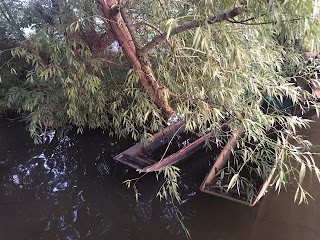
| 4 August 2021. Punts in the morning. |
The Library Records collection affords a unique opportunity to explore these subjects; and during the period of my fellowship (August to September 2021), I have been reading letters sent to Bodleian Library Assistant George Parker, and his daughters, Angelina Frances New (nicknamed Annie) and Evaline Gertrude Parker. I am given to understand that as Keeper of the Harleian Library, you yourself spent much time replying to requests for information, and sharing details of the books in your care with those who could not travel to see them (or who lacked the facility with languages or paleography to access the texts without an intermediary). You would find familiar ground in many of the 2,583 letters I have had the pleasure to read during my fellowship—requests for information about the contents of the library in relation to specific subjects are extremely frequent, and so too are requests from scholars for copies of specific sections of manuscripts or books. Inquirers show a substantial level of interest in the material related to architecture, heraldry, and landholding collected by your correspondent Samuel Carte (bequeathed to the Bodleian by his son Thomas), and the antiquarians Roger Dodsworth and Richard Rawlinson.
| 11 September 2021. A run to Godstow Abbey. |
Angelina and Evaline Parker, and their father George, contributed transcriptions, proof-reading, and research to a number of publications, including W.S. McCormick’s edition of the works of Chaucer, J.A. Herbert’s edition of the Middle English poem Titus & Vespasian or the Destruction of Jerusalem, F.W.D. Brie’s edition of the Brut, and other publications for the Early English Texts society. Indeed, correspondence from most of the editors of EETS volumes published between the late 1880s and 1910s are found in the Library Records collection. A number of letters are from Frederick James Furnivall, the redoubtable founder of that society, and his colleague Walter Skeat—who clearly regarded the Parker family (especially Annie) as trusted authorities on Oxford manuscripts. While the Parkers’ paleographic specialisms and interests do not seem to have entirely intersected with yours, theirs being much later, a letter from the antiquary Agnes Gibbons shows that Annie Parker read and transcribed Old English. Further to the subject of learned societies, you will be pleased to learn that there are twelve letters from that distinguished body which you cofounded, the Society of Antiquaries, relating to the researches of its secretary, William Henry St John Hope.
The Parkers’ correspondents were not limited to scholars and antiquaries in Great Britain—they corresponded with antiquaries, genealogists, and scholars in Austria, Bohemia, France, Germany, Italy, Poland, Russia, and the United States. Notable names among the German correspondents include the classicist Theodor Mommsen, the historians Ernst Dümmler and Oswald Koller, and the philologist Max Müller. American correspondents include the economic historian Charles Henry Hull, the art critic Frank Jewett Mather Jr, the writer Imogen Louise Guiney, and the Harvard University professors Chester Noyes Greenough, George Herbert Palmer, and Oliver Sprague. Letters which have some entertainment value as well as being of scholarly interest abound, but rather than recount these in full, I beg leave to refer you to a series of short essays about them, which you can find here.
| My office in the Visiting Scholars' Centre |
As you wrote in your letter on the library of St Paul’s Cathedral, the librarian of that place should be ‘ready to receive strangers,’ and I must acknowledge the welcome I have received from members of the Bodleian Library community. I am very grateful to Neil Iden, Hannah Jordan, Ernesto Gomez, Nicola O’Toole, and other members of the Special Collections team who have shepherded me through archival work in a pandemic with kindness and efficiency. I am enormously grateful to Alex Franklin and Rachel Naismith, for their help in making arrangements for me to come to Oxford, and for making my time here such a great pleasure.
In addition to several helpful conversations about my findings as they progressed, Dr Franklin kindly arranged introductions and meetings with Oliver House, Faye McLeod, Martin Kauffman and Andrew Dunning, with whom I have discussed (respectively) the Library Records collection and special collections enquiries then and now; ways in which my research notes could be used to enhance the Bodleian’s electronic catalogue of these particular Library Records (our conversation also discussed the medieval and early modern records of the Vice Chancellor’s Court—to which I subsequently found reference in letters to the Parkers); and the Parker family’s work with medieval manuscripts. Ms McLeod kindly introduced me to Bethany Hamblen of Balliol, and we have corresponded about George Parker’s work in the Library of that College. I am most grateful for the time these people have taken, and the interest they have shown in my work, and I hope we will continue to correspond as my work progresses. While the time of year and state of the pandemic have meant that I have not been able to organize or deliver any seminars or lectures relating to my work, I would be honoured to do so should opportunities arise in the future.
| 23 August 2021. At work in the reading room. |
Outside of the library, I have been an enthusiastic attender of concerts, particularly at the Holywell Music Rooms and Sheldonian Theatre—joyfully listening to live music for the first time since February 2020. Additionally, I have been training for the Manchester Marathon, and have enjoyed many miles on the beautiful river paths and meadows, that make Oxford such a pleasant place to be. The run to and from the ruins of Abingdon Abbey is a lovely sixteen miles—though it can be extravagantly muddy after heavy rain. I have also enjoyed trips to many of Oxford’s bookstores, and am returning home with many additions to my personal library. Serendipitously, one of these, Genki Kawamura's If Cats Disappeared from the World, is itself in the form of a letter.
| 22 August 2021. Aftermath of a visit to Daunt Books. |
I modestly hope that this letter has been a pleasant diversion from the great labours of your Librarianship, and sign myself, in the manner of Louise Imogen Guiney, a most ‘grateful undergraduate of Sir Thomas Bodley's eternal college,’ to which I anticipate returning on many further occasions. With great gratitude and many happy memories of a delightful and productive visit, I remain, Sir,
Yours very truly,
Hope Williard
Sunday, 12 December 2021
The Mitten Prophet
It's mitten season again! When I last wrote about birds and mittens in the stories of medieval Christian saints, I mentioned that one of the things that surprised me was that Columbanus' miraculous recovery of his lost mittens from a thieving bird was not the only time such an incident occurred in early medieval Latin hagiography.
Mitten Theft in Early Medieval England
A second incident of mitten theft occurs in the biography of the early English saint Guthlac (674-714 CE), written by a monk named Felix at the request of the East Anglian king Ælfwald, sometime between 730 and 740 CE. Guthlac's life of faith made for a dramatic story. Related to the royal family of Mercia, he pursued a military career for nine years, attracting fame and following until at the age of twenty-four he experienced a dramatic religious conversion and entered the monastery of Repton in Derbyshire. After some time learning the monastic way of life and studying the examples of Christian saints, Guthlac sought a more remote and difficult way of life. He chose to move to an island in the Lincolnshire fens called Croyland (modern Crowland) where he seems to have settled from around 699.
Moving to remote places in search of spiritual challenges is a trope of the lives of the saints--and it's a trope of scholarship on those selfsame texts that these places were rarely as deserted as hagiographers made them out to be. Guthlac's fame as a holy man meant that his life as a hermit was not an entirely solitary one. Like many saints in his position, he was regularly visited by petitioners and friends seeking help and advice. Among his visitors were Wilfrid, a fellow holy man, and Æthelbald, the future king of Mercia. In the late twelfth or early thirteenth century, a Lincolnshire illuminator depicted this visit as part of the marvelous Guthlac Roll, an account of the saint's life in pictures. In one illustration, Guthlac sits indoors comforting the exiled king while a third figure--perhaps Wilfrid?--is seated behind them listening.
| St Guthlac in conversation with Æthelbald of Mercia, Harley Roll Y 6, f. 12v. |
After they had spent some time chatting, Guthlac suddenly asked if they had left anything behind in their boat:
Now the Lord showed things that were absent to this man of blessed memory, Guthlac, filling him as with the spirit of prophecy; and so in the midst of their conversation, although he was seated in the house and could not see farther than the entrance, he suddenly began to ask them whether they had left anything in the ship. Wilfrid in reply said that he had forgetfully left his two gloves there. Guthlac declared that his jackdaws had possession of the gloves; and so it proved. Without any delay they leave the dwelling and see a black thief of the raven kind on the roof-top of a certain cottage tearing a glove with its mischievous beak. Thereupon St Guthlac restrained the bird with gentle words, and then, as if conscious of its ill-doing, it left the glove on the top of the cottage and like a fugitive fled westwards. So Wilfrid had the glove brought down from the top of the roof on the end of a stick; then, realizing that it was in the power of the great man to restore the other glove as he had done the first, Wilfrid began to be concerned about the loss of the other glove. ~trans. Bertram Colgrave, Felix's Life of Saint Guthlac (Cambridge: Cambridge University Press, 2009), pp. 124-125
This was not the first time Guthlac had had trouble with mischievous birds: this chapter about mitten theft is the fourth of a set of stories about the saint's interactions with animals. In the first of these stories, a jackdaw stole an unattended manuscript, which was recovered thanks to Guthlac's help, miraculously undamaged despite being dropped in the marsh. The next chapter of the saint's life describes him living in patient and amused tolerance of the further depredations of a pair of jackdaws. It was a sign of Guthlac's holiness that fish, birds, and other animals would come to him when he called and even take food from him. A third chapter of the life describes an instance in which Wilfrid witnessed the saint help a pair of swallows build a nest in his house.
![]() |
| "Thief !" by john.purvis is licensed under CC BY-NC-SA 2.0 |
Wilfrid might have been reassured that all was not lost through these prior experiences of the saint's way with animals but he still only had one of this gloves back. Guthlac, evidently seeing the humor in the situation, told him not to worry about it.
But the man of God noticed that he was greatly troubled in mind by the loss, and began to console him, uttering playful words and promising him that it was within God's power quickly to restore to them the lost article, if their faith did not falter. To be brief, while they were still speaking, three brethren sounded the signal and appeared at the landing-place of this same island. St Guthlac, quicker than words, as was his custom, turned aside towards them with joyful countenance; for always the most excellent grace of charity shone in his face and speech. As soon as he had saluted the brethren one of them immediately bent his head to him and, having thus asked permission to speak, declared that he had found by chance on the way a certain glove dropped from the curved claws of a jackdaw, and showed him the glove. Guthlac smiled for a moment and, taking the glove from his hand, marvelled at the kindness of the divine clemency, and gave thanks in the spirit. Then, bidding the brethren farewell, he returned the glove to Wilfrid as he had previously promised. ~ trans. Colgrave, pp. 124-127.
The providential arrival of three more visitors, one of whom had just so happened to just pick up a glove dropped by a jackdaw, ensured that the story of mitten theft had a happy ending.
Felix's Sources?
Was this story related to Jonas of Bobbio's story about Saint Columbanus miraculously recovering his mittens after a raven flew off with them? It's within the realm of possibility, since by the time Felix was writing, the Life of Columbanus had been in circulation for nearly a century. Felix's quotations, vocabulary, and stylistic motifs show that he was familiar with a number of Latin saint's lives, though scholars do not seem to cite the Life of Columbanus as one of his sources.
One of the ways in which historians work out the relationship between medieval texts is by looking for quotations or shared use of unusual vocabulary. One place to begin is looking at the word our authors use for mittens. Jonas calls Columbanus' gloves tegumenta manuum or wantos (a word which he specifies is local dialect and defines for the reader). Felix, by contrast, consistently uses the Classical Latin word manica--which can refer to long sleeves which cover the hands, a fur muff or gloves, a piece of armor covering the forearms, or manacles. The absence of tegumenta manuum from the Life of Guthlac is not conclusive proof that Felix never read Jonas, and the possibility of a connection between the two is something I will keep exploring. Further investigation of each author's vocabulary could also shed light on possible connections with other authors: Jonas and Felix were not alone in their interest in birds stealing mittens.
![]() |
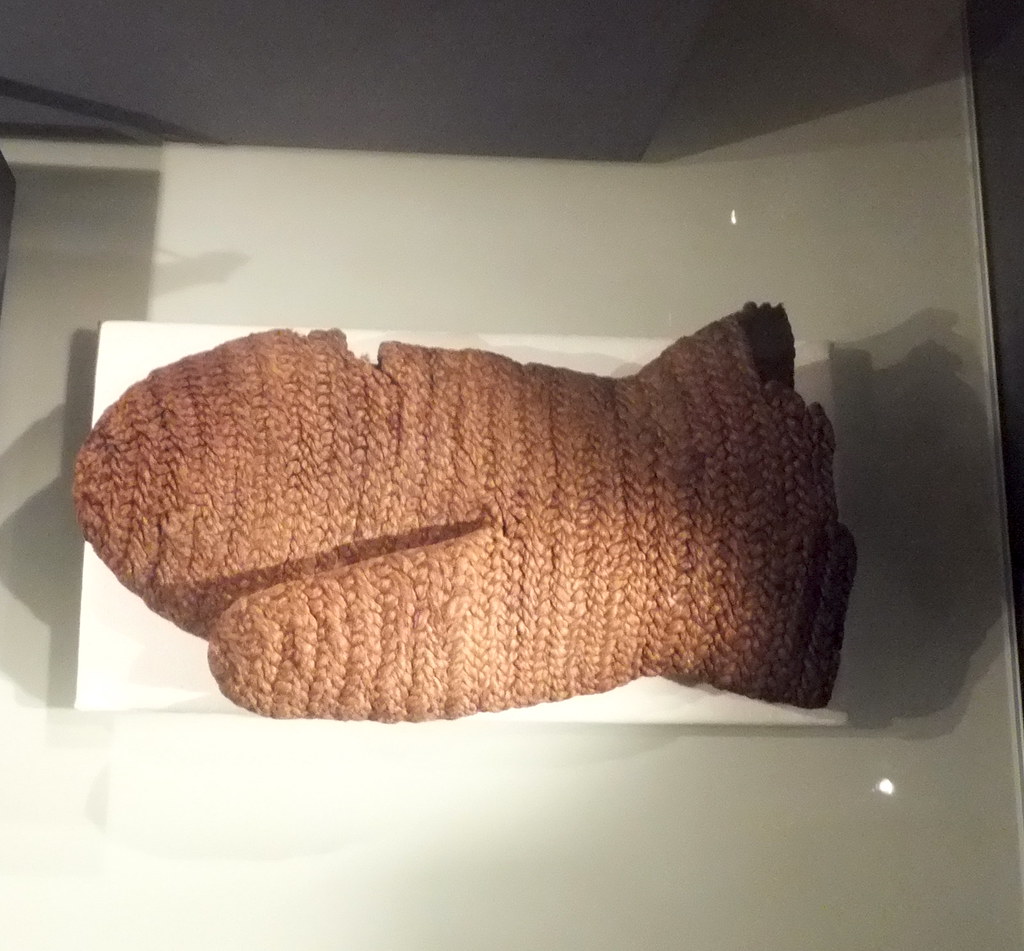
| "Medieval mitten, National Museum of Iceland" by Lebatihem is licensed under CC BY-NC-ND 2.0 |
Further Reading
Wednesday, 1 December 2021
Last Day!
It's the last day of November and I have successfully completed NaNoBlogMo! This time of the year is one I endure rather than enjoy--the dramatic disappearance of daylight and demands of this part of the academic year wear on me. It's hard to believe it has gone so quickly.
I have enjoyed the challenge of writing a daily post. I did not end up finished everything I wanted to write--posts about my Humfrey Wanley fellowship and historians in science fiction are still in the pipeline. Oh, and 'tis the season where I should start writing posts about Medieval Mitten Miracles again.
![]() | |
| Get ready for tales of naughty birds flying off with mittens! |
I was inspired and slightly awed by Pat Thomson's post about AcWriMo on her blog Patter--she used the month to get through an entire book draft. Wow! To be clear, she says in the post that she started with 14,000 words already written, and the book is 50,000 words long--but still, writing 36,000 words of academic prose in a month is a FEAT.
I'm not going to try to write a book in a month in 2022, but I plan to take part in AcWriMo myself next year--I might even organise something with other academic writers at my institution. A 7,500 word article is 250 words a day: an achievable but challenging target.
Anyway, I hope you have enjoyed the poems, pictures, recipes, and news about my book! Thank you for reading.
Image credit: "Red-tailed Hawk" by Jon David Nelson is licensed under CC BY-NC-SA 2.0