Tuesday, 23 November 2021

Choosing My Book's Cover

Lawrence Alma-Tadema's painting The Education of the Children of Clovis captured my imagination from the first time I saw it. It captures fundamental details of the Frankish kingdoms ruled by the Merovingians.

The Education of the Children of Clovis, Lawrence Alma-Tadema. Wikipedia Commons.

Present in the painting are the dynamism of the court, the violence of the kingdoms' repeated civil wars, the centrality of royal women, the clerics waiting to record history..and above all, the inseparable blend of Roman and Not Roman that makes the period absolutely intoxicating to study.

So when I finished writing my book, Friendship in the Merovingian Kingdoms: Venantius Fortunatus and His Contemporaries, there was only one image I wanted on the cover. This one, which says everything I hope that the book says.

Unfortunately, the painting is privately owned, and despite images of it being in the public domain, my publisher told me that copyright concerns would prevent us from using it. 

I grasped at the straws of other Lawrence Alma-Tadema paintings, including this amazing depiction of some late Roman ladies but sadly these too presented copyright issues.
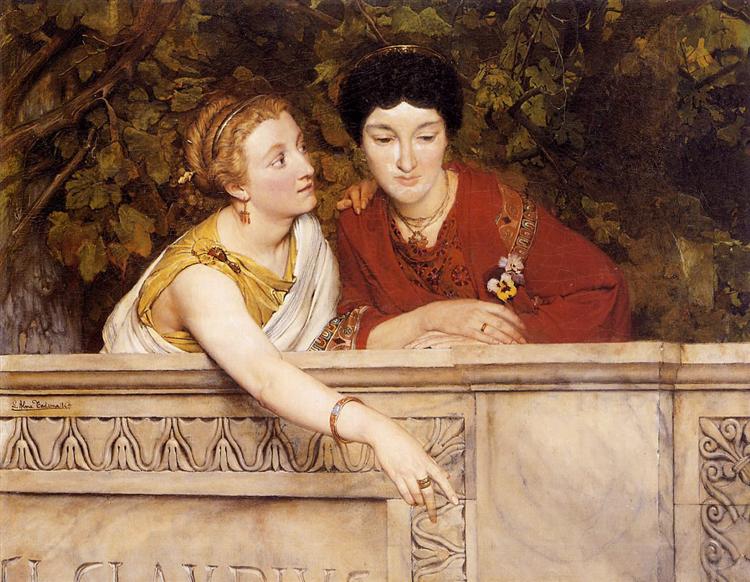
Gallo Roman Women, 1865 - Sir Lawrence Alma-Tadema
Gallo-Roman Women, Lawrence Alma-Tadema. Source: Wikiart.

Alma-Tadema's Venantius Fortunatus Reading His Poems to Radegunda, which is absolutely delightful, would be a very strong choice, but this was used on the cover of Michael Roberts' splendid 2009 book about Fortunatus, The Humblest Sparrow, and I wanted my book to have its own image.
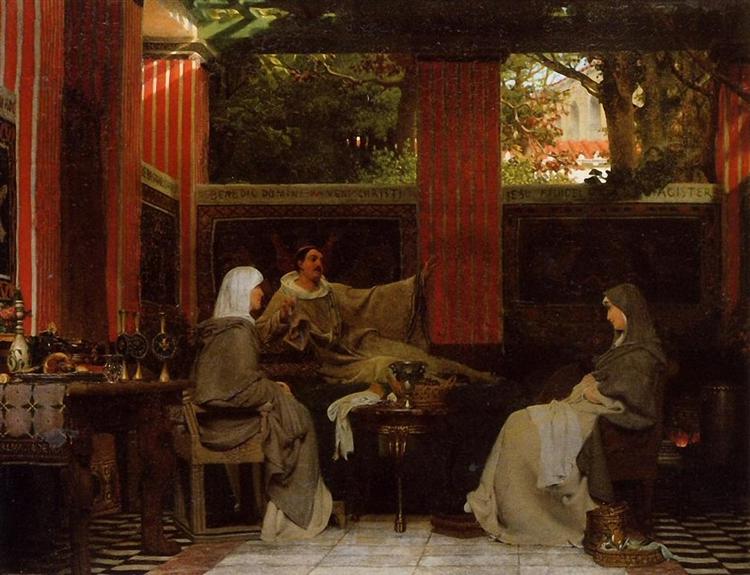
Venantius Fortunatus Reading His Poems to Radegonda VI, 1862 - Sir Lawrence Alma-Tadema
Source: Wikiart.

(Isn't it an amazing painting? Look closely. The fine details of Fortunatus declaiming and of the room he, Radegund, and Agnes occupy, get me every time.)

The production editor suggested that I look specifically at digitised images from museum collections marked as free to reuse, so I made a shortlist of some alternatives.

A graceful, forlorn hand holding a scroll.

Marble left hand holding a scroll, Marble, Roman
Marble left hand holding a scroll, Metropolitan Museum of Art

A portrait of Venantius Fortunatus himself, wielding his pen, found in a medieval manuscript of one of his saints' lives.

Poitiers BM Ms 250 (136), f. 21v.

There is another lovely image from the same manuscript which tempted me greatly--an illustration of one of the miracles of Fortunatus' beloved patron and friend Radegund.

Poitiers BM Ms 250 (136), f.37v.

I love it because it looks like a small group of friends having a chat, something which is very well in keeping with the themes of the book.

Finally, after sorting through all of these choices, I discovered that the Rijksmuseum seems to have a public domain version of a print of the The Education of the Sons of Clovis; not quite as vibrant as the painting but still full of life and movement and community--just like Merovingian friendships.
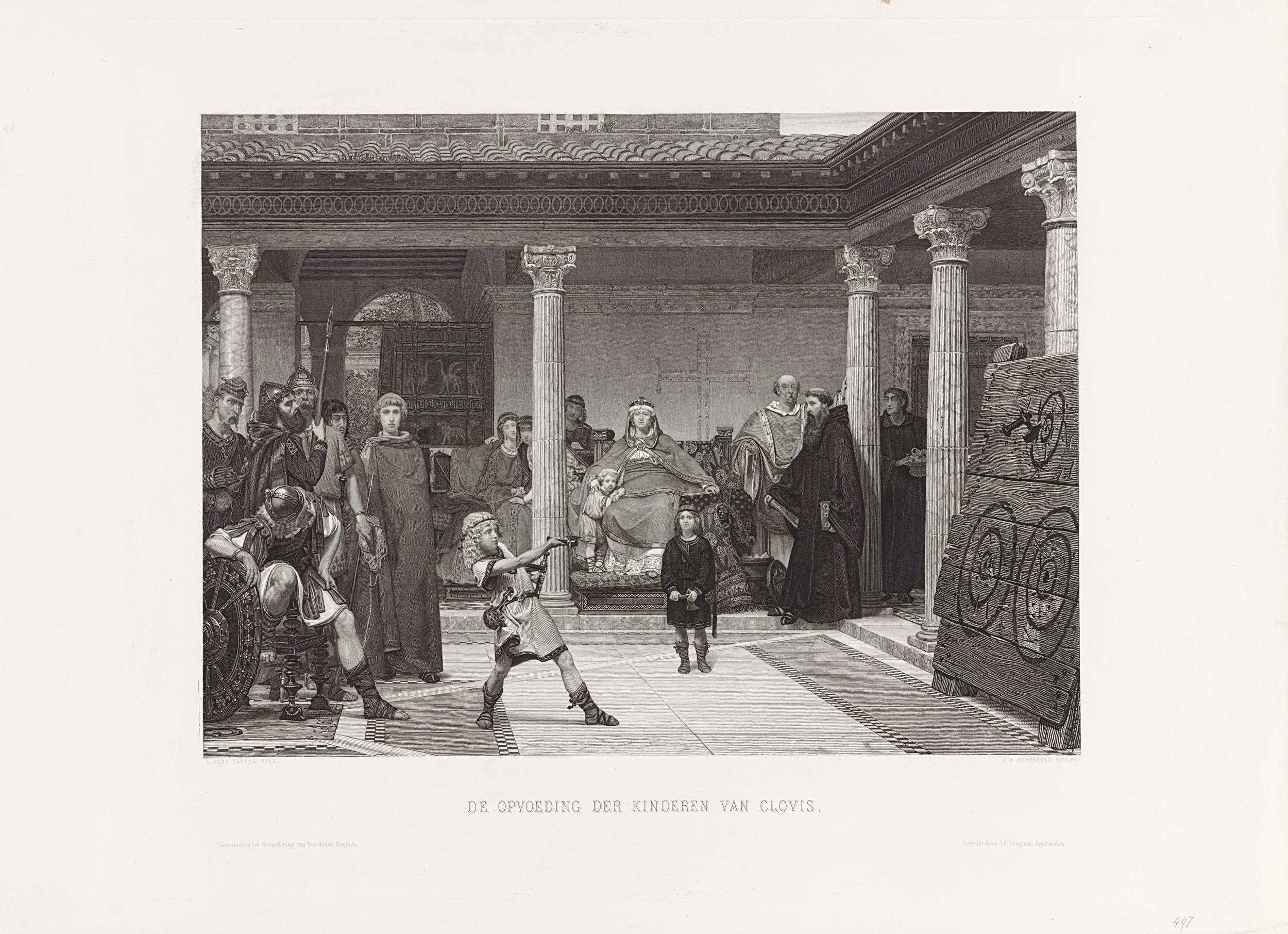
https://proxy.europeana.eu/90402/RP_P_1904_1096?view=https%3A%2F%2Flh5.ggpht.com%2FHRXWYQuNqQz9zvGuAjaef7SuQocSqQRHcpqB9JhOMH9bD1A3DWtJKA7wIID1K7YXlrm5ctLcLP28D7h6MWL8BJhul5Il%3Ds0&disposition=inline&api_url=https%3A%2F%2Fapi.europeana.eu%2Fapi
Source: Europeana

Monday, 22 November 2021

The Thing With Feathers

River Witham, Spring 2021

“Hope” is the thing with feathers -
That perches in the soul -
And sings the tune without the words -
And never stops - at all -

Lincolnshire Wildlife Park, Summer 2021

And sweetest - in the Gale - is heard -
And sore must be the storm -
That could abash the little Bird
That kept so many warm -

Oxford Towpath, August 2021

I’ve heard it in the chillest land -
And on the strangest Sea -
Yet - never - in Extremity,
It asked a crumb - of me.

~ Emily Dickinson

Saturday, 20 November 2021

Shakshuka for a Day Well Spent

What do you cook when you don't want to cook?

When I was a PhD student, I developed a few meals that I would make when I came home from the post-seminar pub, hungry and tired; or when I had a lot of grading to do; or when life became very hectic. They included:

  • popcorn with cheddar cheese, apples, and hot chocolate
  • quick tuna burgers  
  • some kind of pasta situation
  • kale or chard sauteed with garlic and chili over couscous, topped with a fried egg
  • scrambled eggs on toast

There are, however, only so many scrambled eggs one can eat before becoming faintly repulsed by the taste, and in these situations, I would end of making shakshuka, a Tunisian of eggs poached in spicy tomato sauce. Today, when I got home from a lovely hike in the Peak District, I decided it would make a perfect quick dinner.

Ladybower Reservoir, 20 November 2021

I started making shakshuka based on Deb Perlman's recipe from her blog Smitten Kitchen, but adapted it for a solitary hungry diner, like so.

Shakshuka for One

  • 2 tbsp olive oil
  • 1 small onion, chopped
  • 1-3 cloves garlic, depending on size and preference
  • 1 small chili pepper, chopped
  • 1 tsp ground cumin
  • 1/2 tsp ground coriander
  • 1 can chopped tomatoes
  • salt
  • 2 eggs
  • 2 (or more) slices of bread
  • butter

Start by slowly heating your oil while you chop the onion, then toss the onion in and chop garlic and chili. Add to the pot. 

Turn up the heat and give everything a nice stir--it should cook for a few minutes, enough time for the onions to soften and colour a bit. Add spices.

In less than a minute, you'll be able to smell the spices, and can then dump in your canned tomatoes. Stir so that the spices, onion, chili, garlic and tomatoes are all mixed together. Sprinkle with salt.

Let your tomato sauce cook for a bit while you locate eggs, toast, and butter.

Crack eggs into tomato sauce, and cover your pot with a lid so that the eggs cook before the tomato sauce scorches (if you have a hob that heats up quickly, or are prone to scorching food, turn the heat down at this stage).

Toast your bread to your liking; give it a nice coat of butter when it is done. 

Your eggs are done when the white has formed a thin, opaque film over the egg yolks, so that they are just invisible. If you like runny yolks, stop here; if you don't you may want to leave the pan on the heat a few minutes longer.

When eggs are cooked to your liking, transfer eggs and tomato sauce to a shallow bowl.

Eat with a spoon, using your buttered toast to mop up the egg yolks and tomato sauce.

Friday, 19 November 2021

What it really means

Sometimes when I'm trying to analyse a medieval text, I can take things too seriously.

Searching out the meaning and implications of every word and phrase, turning the text inside out.

Abingdon Abbey, 6 September 2021

I like how this poem reminds me to hold the text lightly and daydream.

Introduction to Poetry

I ask them to take a poem
and hold it up to the light
like a color slide

or press an ear against its hive.

I say drop a mouse into a poem
and watch him probe his way out,

or walk inside the poem’s room
and feel the walls for a light switch.

I want them to waterski
across the surface of a poem
waving at the author’s name on the shore.

But all they want to do
is tie the poem to a chair with rope
and torture a confession out of it.

They begin beating it with a hose
to find out what it really means.

~ Billy Collins, The Apple that Astonished Paris (University of Arkansas Press, 1996).

Thursday, 18 November 2021

All My Pretty Chickens

So, it turns out the summaries of Race of Scorpions, which I read to have some hope of following the density of a Dorothy Dunnett plot, skipped the events of chapters nine and ten.

Head in Hands
"Head in Hands" by Alex E. Proimos is licensed under CC BY-NC 2.0

Said events, dear reader, messed me up.

Beware: Race of Scorpions is not the charming boat-trip-and-competition-between-merchants-is-fun hi-jinks that is Spring of the Ram

(Good clean fun in that portion of the Niccolo-verse includes faking the plague, setting things on fire, and pretending you've taken a vow of chastity to get out of sleeping with an emperor. Never let it me said that Dunnett novels are undramatic.)

I'm obviously going to keep reading but very gingerly.

And in the meantime, if you have a cat, give it a snuggle and a treat from me.

Wednesday, 17 November 2021

Like herding cats

Yesterday I mentioned my intrepid high school English teacher, who required her students to compose anthologies of writing which mattered to us, and then read one of our choices aloud and explain why it mattered to us. Here is the piece I read for that assignment.

I don't remember what I said then, but if I had to tell you why it still matters to me now, I'd say that sometimes I think of the line 'shepherding the saints is like herding cats' during faculty meetings and it keeps a smile on my face. Most of all, I love McDonnell's wry deprecation of his brothers and himself. Kindness and a sense of humor, I have learned, goes a long way in being a good member of a community.

stone carvings of beaked birds, in two rows around an archway
Church of St Mary the Virgin, Iffley, Oxfordshire. Detail of west doorway.

The Monks of St. John’s File in for Prayer

In we shuffle, hooded amplitudes,
scapulared brooms, a stray earring, skin-heads
and flowing locks, blind in one eye,
hooked-nosed, handsome as a prince
(and knows it), a five-thumbed organist,
an acolyte who sings in quarter tones,
one slightly swollen keeper of the bees,
the carpenter minus a finger here and there,
our pre-senile writing deathless verse,
a stranded sailor, a Cassian scholar,
the artist suffering the visually
illiterate and indignities unnamed,
two determined liturgists. In a word,
eager purity and weary virtue.
Last of all, the Lord Abbot, early old
(shepherding the saints is like herding cats).
These chariots and steeds of Israel
make a black progress into church.
A rumble of monks bows low and offers praise
to the High God of Gods who is faithful forever.

~ Kilian McDonnell, in Swift, Lord, You Are Not (Collegeville, 2003)

In Sleep A King

In my senior year of high school, our English teacher made us do two things. The first was to choose a Shakespeare sonnet and memorise it. She told us that it would be good for us, and useful one day. For the second, we were tasked with creating an anthology of poems and excerpts from books that mattered most to us at the time, a commonplace book of our seventeen and eighteen year old selves. We were asked to read an excerpt from our anthologies, in front of the entire class; we were also asked to explain why what we chose to read mattered to us. One kid shared the scene from A Clockwork Orange where the protagonist violently enjoys Beethoven. 

What I remember most about both assignments is that we were encouraged respond emotionally to both our Shakespeare and our anthologies. There was no pressure to define what these texts meant or how they worked; no beating the poems with hoses, in the inimitable words of Billy Collins, to find out what they really meant. We were allowed love without judgement.

Because of this, I still remember the poem I chose to read to the class when it was my turn, and my sonnet. Over a dozen years later I can still recite most of it without looking up the text. Particularly over the past few months, as I've missed being in Oxford, it has regularly come to mind. Thus have I had thee as a dream doth flatter / in sleep a king, but waking no such matter.

photo of a sunset over a river
Sunset at Osney Lock, 17 September 2021

Sonnet 87

Farewell! thou art too dear for my possessing,
And like enough thou knowst thy estimate.
The Charter of thy worth gives thee releasing;
My bonds in thee are all determinate.
For how do I hold thee but by thy granting,
And for that riches where is my deserving?
The cause of this fair gift in me is wanting,
And so my patent back again is swerving.
Thy self thou gavest, thy own worth then not knowing,
Or me, to whom thou gavest it, else mistaking,
So thy great gift, upon misprision growing,
Comes home again, on better judgement making.
    Thus have I had thee as a dream doth flatter:
    In sleep a king, but waking no such matter.

~ William Shakespeare