Saturday, 23 December 2023

They were memories

As a historian, I most often work with texts, especially letters. But the past is present in the rest of my life through objects. My grandmother, who died before I was born, was an antiques dealer and collector, and many of her things, and their stories, passed down to my mother, who has an extraordinary visual memory. The question "where did this come from?" is the key to the stories she keeps; it gives access to people and places I will never know. This background makes me readily believe that objects can serve as vessels of memory. 

Recently, I was delighted by a scene in "Summer Nights", a short story by Elizabeth Bowen, where the keepsakes of one of the story's minor characters, Aunt Fran, are described:

Round the room, on the ledges and brackets, stood the fetishes she had traveled through life with. They were memories--photos in little warped frames, musty, round straw boxes, china kittens, palm crosses, three Japanese monkeys, bambini, a Lincoln Imp, a merry-thought pen-wiper, an ivory spinning wheel from Cologne. From these objects the original virtue had by now almost evaporated. These gifts' givers, known on her lonely journey, were by now as faint as their photographs: she no longer knew, now, where anyone was. All the more, her nature clung to these objects that moved with her slowly towards the dark.

Elizabeth Bowen, "Summer Night, " reprinted in The Granta Book of the Irish Short Story, edited by Ann Enright, (London, 2010), pp. 78-9

Imagining this as a gathering of what a shop sign would call "antiques and collectibles", I began to wonder what these objects might look like. "Summer Night" was published in 1941, and Aunt Fran is described as an old lady, so I used the word Victorian in my image searches.

photos in little warped frames: I enjoyed looking at lots of elaborate Victorian photo frames on ebay but chose this very simple example; the adjectives "little" and "warped" suggest something not very elaborate.

frame small brass 2x2.5 inches oval easel stand w/glass
Image source: ebay.com     

musty, round straw boxes: The straw box below isn't the right shape but it was surprisingly tricky to find examples of Victorian straw work. The example below so pretty--I wonder if the decoration technique might be a form of straw marquetry? "Musty", does, however, suggest a little trinket box made entirely out of straw. Decorated wood, like the box below, would likely be sturdier.

Victorian Straw Work Trinket Box with Flower Motif - image 1 of 8
Image source: Rubylane 


china kittens: There are, as anyone who has gone into an antique store knows, a lot of cat figurines in this old world. With boxes still on my mind, I thought this was an utterly charming examples of china kittens.
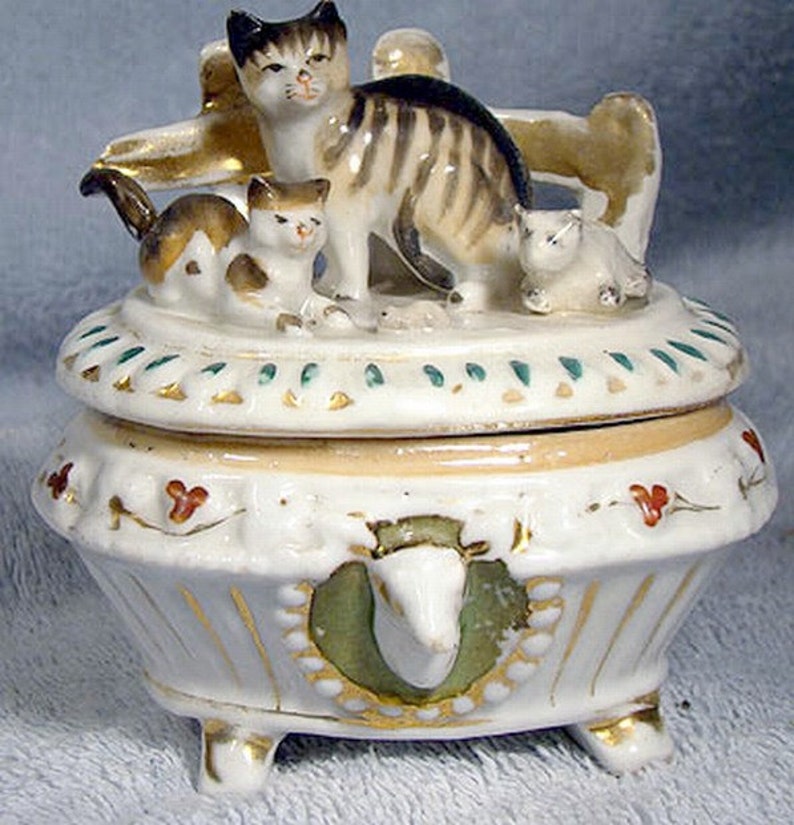
three small china cats on an antique white china casket
Image source: etsy.com


palm crosses: Given the tone of the passage and the other keepsakes on Aunt Fran's shelves, I imagine these being kept as mementos of time spent with loved ones, as well as for their value as religious objects. Passages of the Bible which describe the arrival of Jesus Christ in Jerusalem, shortly before his execution, mention that the crowds which accompanied him and his disciples were carrying palm branches. Palm Sunday, the commemoration of this event in the Christian religious calendar, is celebrated on the Sunday before Easter; many churches include a procession with palms in their celebrations. These palms are often made into crosses and kept until the church service that marks the start of Lent.
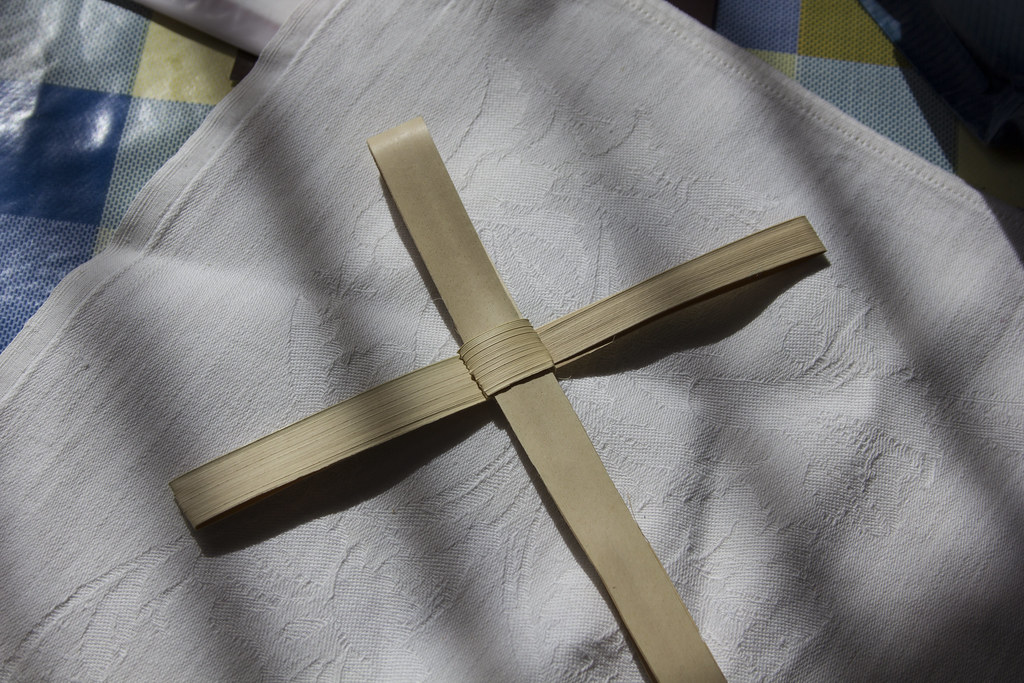
Good Friday: Palm Cross
"Good Friday: Palm Cross" by Dai Lygad is licensed under CC BY 2.0.

three Japanese monkeys: While the story doesn't say, enough of my searches for "Victorian Japanese monkeys" came back with these "speak no evil, hear no evil, see no evil" monkeys that I thought Aunt Fran's figurine was probably similar.

Antique Japanese Meiji Brass Three Wise Monkeys figurine
Image source: ebay.com

bambini: Dear reader, do you know what this would be? I know that bambini is the Italian word for "babies," but Google searches for terms like "Victorian bambini" were useless. Websites like ebay, which have lots of antiques for sale, didn't seem to have items specifically listed under this term either. Suspecting that bambini is a word, like putti, which refers to something specific, I looked it up in the dictionary. Bambini is "a representation of the infant Christ." Most of the images I was able to find were described by their sellers as figurines from nativity scenes. Here's one example. Again, the presence of this object this suggests both religiosity and the social side of religious observance. If Aunt Fran's figurine was a baby Jesus from a manger scene, it may have reminded her of decorating for the holidays with members of her family.

figurine of a white baby wearing a white cloth diaper, representing the infant Jesus
Image source: ebay.com

a Lincoln Imp: As a former resident of Lincoln, I was charmed to see its famous gargoyle among Aunt Fran's collectibles. Most Lincoln Imps seem to have been in the form of teaspoons or door knockers. After scanning several pages of search results, I came across this charming little paperweight, who looks like the sort of thing one might keep on a ledge or bracket as a memento. I wouldn't have though them especially common in Ireland (or indeed, outside of Lincoln), so its presence suggests a traveling friend or relative.

Brass Lincolnshire Lincoln Imp paperweight
Lincoln Imp Paperweight (Image source: ebay.com)

Merry-thought penwiper: At first I thought that 'merry-thought' was simply an adjective, and the object could have been any sort of penwiper (perhaps this astonishingly cute cat-shaped one?) But no, the full phrase is a proper noun! The merry-thought pen wiper is a doll made from a wishbone, used as a pen-wiper; the Cambridge Public Library features newspaper instructions on how to make one here and the blog Victorian traditions has a delightful selection of pictures of them here. Something to do with the wishbone of your Christmas turkey, perhaps?

Lastly, the ivory spinning wheel from Cologne! This was another object that I struggled to identify. Why is it significant that the ivory spinning wheel is from Cologne? My searches turned up many examples of carved ivory from medieval Cologne, but almost no information on ivory carving in nineteenth or twentieth century Cologne. However, the German town of Erbach was and is a centre for ivory carving; it even has a museum with examples of ivory carving from around the world. Being absolutely exact, the auction house which sold the little ivory spinning wheel below concluded it was made in France or Flanders, not Germany, but it is too charming not to share.
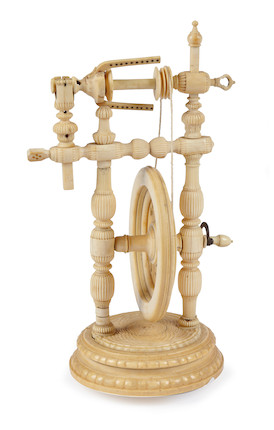
miniature spinning wheel made of ivory
Image source: Bonhams.com

A character's things and how they feel about them are so evocative, aren't they? Aunt Fran is, for the other characters in "Summer Night", unsympathetic and irritating. As a reader, her attachment to her shelves full of treasures and the memories they hold caught my attention. Thinking about these objects, where they came from, and what they looked like, enriches my understanding of Aunt Fran's character by hinting that she once had a wide circle of friends and family, who went with her to church, and  traveled--to Germany, England, Japan--and brought her back gifts. The gifts' givers are dead, estranged, or out of touch, but their memories remain.

The full text of Look at all these roses, the short story collection where "Summer Night" was originally published, can be found on the Internet Archive here.

Tuesday, 19 December 2023

Dreams that would split the brain of Caesar

Curating an anthology is a skill that fascinates me (as I've written before). While I enjoy collections of poems or short stories written by a single person, I love the element of surprise that a good anthology provides. In older anthologies editorial intervention is often delightfully discreet --while there may be short foreword explaining what materials have been selected and why, there are no explanatory notes or biographies of authors. The stories are left to speak for themselves.

Which is to say--if you run across a copy of the anthology 50 Great Short Stories, edited by an American professor of English, Milton Crane (1917-1985), pick it up and read it. Crane's tastes are old-fashioned: most of the stories he selected were written before the Second World War; and the majority of them are by British or American men. Nine of the fifty stories are by women, which seems like a pretty good proportion for a collection originally published in the 1950s.

The fact that the stories in this anthology are the sorts of stories that were popular in a bygone age makes 50 Great American Short Stories a wonderful book for encountering the work of writers whose work has fallen out of fashion in the twenty-first century. Stephen Vincent Benét (1898-1943) seems to be one such; in his own day he was a best-selling and prizewinning poet. I have a vague memory of encountering his most famous short story, "The Devil and Daniel Webster," in one of my many happy hours browsing the Norton Anthology of Literature during my high school English classes, but the author's name hadn't stuck in my memory.

Benét's short story "The Curfew Tolls," was one of my favourite finds in this collection. The frame of the story is a series of letters by a retired British general, Estcourt, sent to the coastal watering place of St. Philippe-des-Bains to recover his health in 1788. (Why the dates of the letters matter is revealed over the course of the story.)

The 1983 edition of 50 Great Short Stories (originally published in 1959).

The story's epistolary frame is the perfect vehicle for long, chatty descriptions of people, places, and conversations. As narrator, Estcourt is determined to amuse himself, and his sister Harriet, with whom he is corresponding, by finding and befriending characters among the locals. The chief among these is an officer, retired from the French army, whose contradictions puzzle and fascinate him. Witness one of their conversations:

"And what is treason?" he said lightly. "If we call it unsuccessful ambition we shall be nearer the truth. He looked at me, keenly. "You are shocked, General Estcourt," he said. "I am sorry for that. But have you never known the curse"--and here his voice vibrated--"the curse of not being employed when you should be employed? The curse of being a hammer with no nail to drive? The curse--the curse of sitting in a dusty garrison town with dreams that would split the brain of Caesar and no room on earth for those dreams?"

"Yes," I said, unwillingly, for there was something in him that demanded the truth. "I have known that."

- Stephen Vincent Benét, 'The Curfew Tolls", in 50 Great Short Stories, ed. Milton Crane, p. 306

Their frustrated ambitions and shared passion for military strategy provide the foundations for an odd sort of friendship, which deepens when Estcourt meets the officer's large and disreputable family. I particularly love Benét's description of the redoubtable family matriarch:

Only the old lady remained aloof, saying little and sipping her camomile tea as though it contained the blood of her enemies. - Stephen Vincent Benét, 'The Curfew Tolls", in 50 Great Short Stories, ed. Milton Crane, p. 309.

The officer's name is not revealed until the very end of the story, but clues to his identity are given throughout, including in his dramatic deathbed speech:

"Risen?" he said, and his eyes flashed. "Risen? Oh, God, that I should die alone with my one companion an Englishman with a soul of suet! Fool, if I had had Alexander's chance, I would have bettered Alexander! And it will come, too, that is the worst of it. Already Europe is shaking with a new birth. If I had been born under the Sun-King, I would be a Marshall of France; if I had been born twenty years ago, I would mold a new Europe with my fists in the next half-dozen years. Why did they put my soul in my body at this infernal time. Do you not understand, imbecile? Is there no one who understands?" - Stephen Vincent Benét, 'The Curfew Tolls", in 50 Great Short Stories, ed. Milton Crane p. 312.

It wasn't until the final paragraphs that I realized why the lack of a name mattered, and this twist made for a reading experience I would recommend. 

"The Curfew Tolls" can be read online here.

Sunday, 3 December 2023

If You Read Enough Books, You Overflow

One of the last books I checked out of the Lincoln Central Library before I moved away was Terry Prachett's A Slip of the Keyboard. Pratchett is one of those authors who has been on edges of my awareness for awhile--I was given a copy of Good Omens over a decade ago, and loved it (I could also go on, at length, about how much I adore the television show), but I hadn't stumbled into reading any of his other writings. 

cover of a slip of the keyboard by terry pratchett
A Slip of the Keyboard by Terry Pratchett

A Slip of the Keyboard changed that. It was, of course, helpful that I found it exactly at the right time--anthologies with short chapters are good for moving, or times of upheaval in general, because you can pick them up and put them down without losing the plot. The book collects Pratchett's essays, speeches, and other non-fiction pieces. It is full of delightful moments. Consider this reflection on his experiences at the start of his career:

I was lucky. Incredibly so, when I think of all the ways things could have gone. But when the floppy-eared Spaniel of Luck sniffs at your turn-ups it helps if you have a collar and a piece of string in your pocket. In my case, it was a sequel. (p. 21)

I can picture the Spaniel of Luck, can't you? It's probably the type of dog who gets excited and beats a tattoo with its tail. Neil Gaiman's introduction reflects beautifully on the contrast between Pratchett's image as a jolly funnyman and the outrage against injustice that drives much of his work. Outrage aside, moments of exasperation are among the delights of these pieces. One of my favourites is his pithy comment on the internet:

The ethos of the internet was evolved by people who did not have to pay their own phone bills. (p. 79)

But there's also his comment on the rebranding of librarianship:

Not long ago I was invited to a librarians' event by a lady who cheerfully told me, 'We like to think of ourselves as information providers.' I was appalled by this want of ambition: I made my excuses and didn't go. After all, if you have a choice, why not call yourselves Shining Acolytes of the Sacred Flame of Literacy in a Dark and Encroaching Universe? I admit this is hard to put on a button, so why no abbreviate it to librarians?....It seemed to me, even in those days, that librarians and their ilk were not mere 'providers.' (p. 143)

This is part of a passage describing his experience working as a volunteer librarian. I like his point that librarians do more than simply provide access to information, they help people navigate it. (I also think he's on to something about the way that information professionals can often struggle to "TAKE UP SPACE", as my middle school violin teacher would memorably shout at me when I slouched.)

Another passage I want to copy out and wave at everyone I know (the point of this post, if there is one), comes from his inaugural lecture as a professor at Trinity College, Dublin. It's a passage I want to put in a course handbook one day:

Vice-chancellor, venerable staff, guests, students, and graduates, I hope that no one will take it amiss when I say that what we are in fact doing today is celebrating ignorance. Ignorance is generally an unregarded talent among humans, but we are in fact the only species that knows how to do it properly. We've got where we are today by starting out ignorant. It wasn't always like this. A few thousand years ago, we knew everything--how the world began, what it was for, our place in it...everything. It was all there, in the stories the old men told around the fire or had written down in a big book. No more questions, everything sorted out. But now we now that there's vast amounts of things that, well, we simply don't know, Universities have made great efforts in this area. Think about how it works: you arrive at university, the gleam still on your A-levels, and you've pretty well got it all sussed. Then the first thing they tell you--well, the second thing, obviously, because they have to tell you where the toilets are and so on--is that what you've learned so far is not so much the truth as it is a way of looking at things. And after three years or so you've learned that there's a huge amount you don't know yet, and that's when they give you a scroll and push you out. Ignorance is a wonderful thing--it's the state you have to be in before you can really learn anything. (p. 149)

It's not quite correct--as a medievalist, I take issue with the idea that rigid, patriarchal certainty about the way the world works (or should work), is a thing of the past--it seems to be doing very well for itself in the twenty-first century. But the real point, that one of the outcomes of becoming truly educated is realizing with wonder and humility just how infinitely much there is to learn--is something I hope to convey in my own teaching.

Some of the loveliest moments in the book are when Pratchett reflects on his own development as a writer. I love his account of writing a fan letter to Tolkien and getting a response back.

...when I was young, I wrote a letter to J.R.R. Tolkien, just as he was becoming extravagantly famous. I think the book that impressed me was Smith of Wotton Major. Mine must have been among hundreds or thousands of letters he received every week. I got a reply. It might have been dictated. For all I know, it might have been typed to a format. But it was signed. He must have had a sackful of letters from every commune and university in the world, written by people whose children are now grown up and trying to make a normal life while being named Galadriel or Moonchild. It wasn't as if I'd said a lot. There were no burning questions. I just said I'd enjoyed the book. And he said thank you. For a moment, it achieved the most basic and treasured of human communications: you are real, and therefore so am I. (p. 76)

Writers on the craft of writing can be a bit hit or miss, and a secondary industry to the writing advice industry is the don't-take-that-writing-advice-industry, where people explain their allergies to old chestnuts such as "write every day". A Slip of the Keyboard is not a book of advice, but I found this passage especially useful.

Read with the eye of a carpenter looking at trees. Apply logic in places where it  wasn't intended to exist. If assured that the Queen of the Fairies has a necklace made of broken promises, ask yourself what it looks like. If there is magic, where does it come from? Why isn't everyone using it? What rules will you have to give to allow some tension in your story? How does society operate? Where does the food come from? You need to know how your world works. (p. 85)

And lastly, in a book stuffed with great one-liners, this is among the book's best:

And I went on reading; and, since if you read enough books you overflow, I eventually became a writer. (p. 126)

Inspired by A Slip of the Keyboard, one of the first books I checked out from my new public library, de Bibliotheek Utrecht, was their extremely battered copy of Reaper Man, which I loved. I'm currently testing the integrity of the tape binding holding together their copy of The Truth. There is more Terry Pratchett in my future. May we all read to overflow in what remains of this year and the ones to come, and thanks to Sir Terry for helping us do it.

Sunday, 26 November 2023

Invent Your Way Out

Here's a thing: I trust the label "classic." So when I saw the red spine of Bernard Malamud's The Magic Barrel, a collection of short stories first published in 1958, and republished in Penguin's Vintage Classics series in 2002, I happily plucked it off the library shelf and brought it home with me. Malamud is a very famous American writer, with a major short-story writing award named after him, but I had never heard of him.

The Magic Barrel by Bernard Malamud

Discovering his stories was marvelous fun, not least because they are well-crafted and wise. Take, as a delightful example, this conversation about writing between the two characters of "The Girl of My Dreams":

Olga reached into her market bag and brought out several packages. She unwrapped bread, sausage, herring, Italian cheese, soft salami, pickles and a large turkey drumstick. 

 'Sometimes I favor myself with these little treats. Eat, Mitka.'

Another landlady. Set Mitka adrift, and he enticed somebody's Mama. But he ate, grateful she had provided an occupation.

The waiter brought the drinks. 'What's going on here, a picnic?'

'We're writers,' Olga explained.

'The boss will be pleased.'

'Never mind him, eat, Mitka.'

He ate listlessly. A man had to live. Or did he? When had felt this low? Probably never.

Olga sipped her whiskey. 'Eat, it's self-expression.'

He expressed himself by finishing off the salami, also half the loaf of bread, cheese, and herring. His appetite grew. Searching within the bag Olga brought out a package of sliced corned beef and a ripe pear. He made a sandwich of the meat. On top of that the cold beer was tasty.

'How is the writing going now, Mitka?'

He lowered the glass but changed his mind and gulped the rest.

'Don't speak of it.'

'Be uphearted, not down. Work every day.'

He gnawed the turkey drumstick.

'That's what I do. I've been writing for over twenty years and sometimes--for one reason or another--it gets so bad that I don't feel like going on. But what I do then is relax for a short while and then change to another story. After my juices are flowing again I go back to the other and usually that starts off once more. After you've been writing so long as I you'll learn a system to keep yourself going. It depends on your view of life. If you're mature you'll find out how to work.'

'My writing is a mess,' he sighed. 'a fog, a blot.'

'You'll invent your way out,' said Olga, 'if you only keep trying.' (The Magic Barrel, pp 30-31) 

Inventing their way out seems to be something all of Malamud's characters do, in one way or another. The astonishing final story, 'The Magic Barrel', features a hapless rabbinical student, Leo Finkle, employing a matchmaker to find him a wife. To one of these prospective brides, Finkle explains his religious calling:

'I am not,' he said gravely, 'a talented religious person,' and in seeking words to go on, found himself possessed by shame and fear. 'I think,' he said in a strained manner, 'that I came to God not because I loved Him, but because I did not.' This confession he spoke harshly because its unexpectedness shook him. (The Magic Barrel, p. 164).

"A talented religious person," is a wonderful resonant phrase, and The Magic Barrel is full of moments like this. I recommend it.

Sunday, 5 November 2023

Everybody loves a bonfire

Guy Fawkes

Humber Estuary: 1955

The last thing our Guy Fawkes will see
is the sea coming in to rescue him.
But the sea won't reach. The rockets
and Catherine wheels will reach,
 
but the tide is too low to douse a fire.
Shriveled to penny eyes and shells for teeth,
his ashes will drift to the estuary,
his wide mouth leak the oils and tars
 
of Sheffield's industrial froth.
Push-netters shrimping the shallows
might have helped if they had heard,
but they're ranters and levellers to a man.
 
bonfire at ocean beach
"bonfire at ocean beach" by maywong_photos is licensed under CC BY 2.0      
Everybody loves a bonfire.
Everybody loves to see Guy Fawkes burned.
The crowds will pay sixpence for fresh crab
and shrimps in brown paper bags.
 
The last thing our Guy Fawkes will see 
is the cocklers and inshore fishermen,
warm in tarred oilskins and sou'westers
pretending they are boys again,
 
shouting for the death of the straw man,
the fire of belief in their eyes,
the fists of the future in their hands.
a dance of screaming crowds in the sea.
 
~ William Bedford, The Dancers of Colbek (2020), p. 19

Sunday, 29 October 2023

New Recipes of Exciting Times

If at the beginning of March you had asked me, 'Where do you see yourself in October?', my answer would not have been 'in a new country.' After twelve years in the UK, it's a surprise and delight to find myself in the Netherlands! At the beginning of September, I moved to Utrecht to start a postdoc on early medieval letter writing. So far so good--my colleagues and my work are wonderful, and the first two months have flown by.

Looking back over what I've cooked this year, what stands out is my purchase of a slow cooker in the late winter, and the period where I was interviewing for my new job (March and April) and moving (August and September). Change is hard on one's desire to cook new things, but I'm starting to feel settled in to my new kitchen, and looking forward to seeing what I'll cook here.

March

  • Sabath masoor ki dal (brown lentils with onions, tomatoes, and ginger), Indian Slow Cooker
  • Rajma (red kidney beans), Indian Slow Cooker
  • Whole wheat spaghetti with roasted squash (source unrecorded)
  • Avocado Chocolate Pudding from Leite's Culinaria 
 

 April

  • Hare moong ki khichdi (green mung beans and rice), Indian Slow Cooker
    Indian slow cooker: recipes for curries, dals, chutneys, masalas, biryani, and more
    I'd recommend this cookbook (as you can tell by the number of recipes I tried from it!)

 May

  • Parsnip miso soup with sticky parsnip peel, Waitrose
  • Lime and miso dressing, Natural
  • Rosario Guillermo's Black Bean Charros, World Vegetarian
  • Chana masala, Indian Slow Cooker

 June

  • Tembal Dolma (cabbage with rice and currants), World Vegetarian
  • South Indian Carrot and Ginger Relish, World Vegetarian
  • Swedish Limpa Bread, Heartland

July

 September

October

  • Winter Squash Soup with Red Onion Crisp, Smitten Kitchen Keepers
  • Chickpeas Cooked in a Moghlai Style, World Vegetarian
  • Risotto with tomato and aubergine, World Vegetarian
  • Pumpkin with Sultanas, World Vegetarian
    https://images.awesomebooks.com/images/books/large/97800/9780091863647.jpg
    World Vegetarian continues to be one of my favourite cookbooks!

Sunday, 1 October 2023

A Diptych for Molly

I go down to the shore

I go down to the shore in the morning
and depending on the hour the waves
are rolling in or moving out,
and I say, oh, I am miserable,
what shall —
what should I do? And the sea says
in its lovely voice:
Excuse me, I have work to do.

~ Mary Oliver, A Thousand Mornings, p. 1 

a dock on the ocean with a bare tree and blue sky
20 December 2022

I ask Percy how I should live my life

Love, love, love, says Percy.
And hurry as fast as you can
along the shining beach, or the rubble, or the dust.

Then, go to sleep.
Give up your body heat, your beating heart.
Then, trust.

~ Mary Oliver, Red Bird: Poems via Words for the Year

2 September 2023 (A.C. Williard)